Illustrated by Julianne Park. All rights reserved.
Artificial Intelligence has been on everyone’s mind since OpenAI released the first demo of ChatGPT to the public in November of 2022. It quickly gained over a million users with its stories, travel planning, coding, and so much more. Since then, the popularity of AI has only risen, with corporate AI investment reaching $252.3 billion and private investment in generative AI reaching $33.9 billion in 2024. This rapid growth, however, comes at a cost.
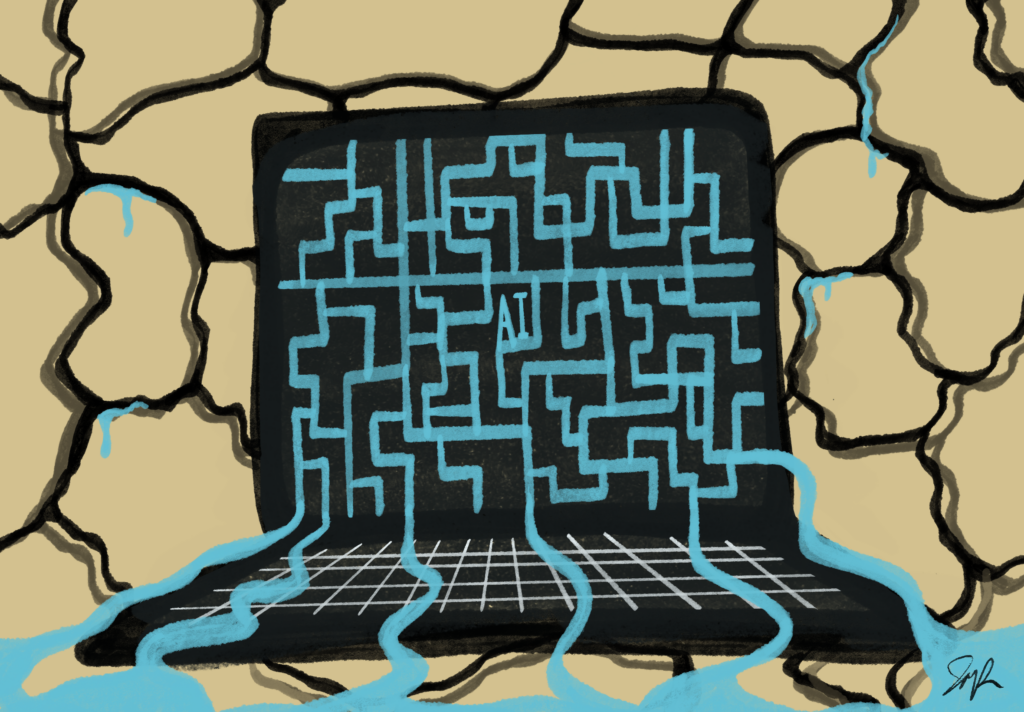
AI requires large amounts of energy from data centers, which use large amounts of freshwater as coolants to prevent overheating. Large data centers can consume up to 5 million gallons of freshwater per day. The rapid increase in demand for AI data centers has put pressure on a straining resource; only 3% of Earth’s water is freshwater, and only 0.5% of all water is accessible and safe for humans. As of 2025, the United Nations states that over two billion people worldwide don’t have access to safe drinking water, and half of the world’s population is experiencing severe water scarcity for at least part of the year. These numbers are only expected to increase due to factors such as climate change and population growth. According to Google’s 2025 Environmental Report, 28% of freshwater withdrawals came from sources at medium to high risk of water depletion or scarcity. The main issue with AI is not robot takeovers or energy use, it’s water.
It is also important to note that Artificial Intelligence is not going away: the global AI market was worth $390.9B in 2025 and is set to hit $3.5T by 2033. The focus should be on regulating this growth and the ways companies can use finite resources such as freshwater. There are many ways to minimize the amount of freshwater necessary for cooling that are not being utilized because it is currently cheaper for the companies to just take, the goal should be to make sustainable options the most appealing to companies, and the best way to do this is by making them the cheapest. This can mean regulations and fines on using certain amounts of potable water or creating tax benefits for using recycled, non potable, or industrial runoff water and creating data centers that use air cooling or reuse heat. They could also reward the integration of renewable energies such as solar, wind, or nuclear to reduce the pressure on fossil-fuel power plants.
When pushing for new regulation, especially in a growing industry such as Artificial Intelligence, it is important to start on the local and regional level. It can be as simple as putting up posters around schools or in businesses to raise awareness of the issue, speaking to the city council or boards that approve zoning, permits, and water allocations. Speak to state environmental agencies in charge of setting water-use rules and reporting requirements. The goal should be to set regulations in the areas the data centers are being built. Individuals and groups can push for laws that require companies to publish their Water Usage Reports to the public. Forcing companies to take accountability for their water use helps encourage sustainable alternatives and growth.
Artificial Intelligence is a complicated topic, and likewise, it helps as much as it harms in many cases. As such, there is not a perfect solution to the AI water crisis, only compromises. The best way to ensure companies grow sustainably is to hold them accountable: push for change in the community and others will follow.
Works Cited
“A Guide to Industrial Cooling Systems.” Johnsoncontrols.co.uk, 2024, www.johnsoncontrols.co.uk/insights/2024/blogs/guide-to-industrial-cooling-systems.
Barnett, Jamiya. “How Water Reuse Can Address Scarcity | Article | EESI.” Eesi.org, 2024, www.eesi.org/articles/view/how-water-reuse-can-address-scarcity.
“4 Types of Industrial Cooling Systems | Water Cooling Applications | Delta Cooling Towers, Inc.” Manufacturers of Cooling Towers & Systems by Delta Cooling Towers, Inc., 7 Apr. 2022, deltacooling.com/resources/faqs/industrial-cooling-systems.
“Google 2025 Environmental Report.” Gstatic.com, Google, June 2025, www.gstatic.com/gumdrop/sustainability/google-2025-environmental-report.pdf.
Li, Pengfei, et al. Making AI Less “Thirsty”: Uncovering and Addressing the Secret Water Footprint of AI Models. 26 Mar. 2025.
Marr, Bernard. “A Short History of ChatGPT: How We Got to Where We Are Today.” Forbes, 19 May 2023, www.forbes.com/sites/bernardmarr/2023/05/19/a-short-history-of-chatgpt-how-we-got-to-where-we-are-today/.
Stanford.edu, 2025, hai.stanford.edu/ai-index/2025-ai-index-report/economy.
United Nations. “Water – at the Center of the Climate Crisis.” United Nations, 2022, www.un.org/en/climatechange/science/climate-issues/water.
Woolf, Max. “88+ Artificial Intelligence Statistics for 2026.” Home, 2 Nov. 2023, photoaid.com/blog/ai-statistics/.
Yañez-Barnuevo, Miguel. “Data Centers and Water Consumption | Article | EESI.” Eesi.org, 25 June 2025, www.eesi.org/articles/view/data-centers-and-water-consumption.
The views and opinions expressed are those of the authors and do not necessarily reflect nor represent the Earth Chronicles and its editorial board.