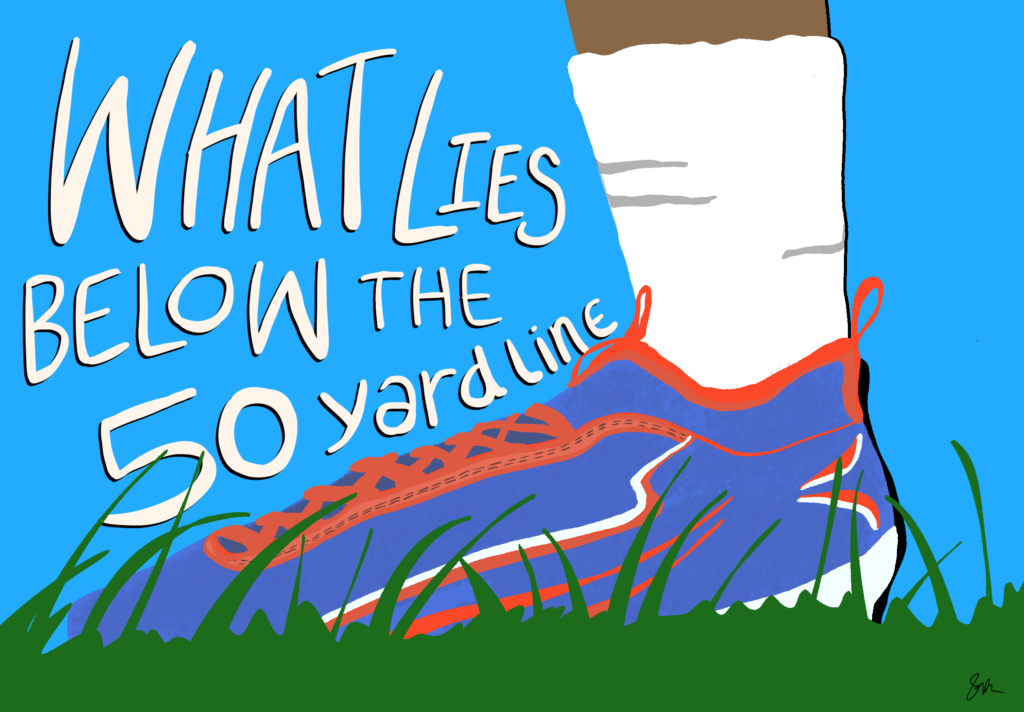
With the Super Bowl quickly approaching, all eyes will be fixed on Santa Clara’s Levi’s Stadium, where two football teams will strive to carve their names into the echelon of U.S. sports history. This made me wonder how I could use my research lens to explore questions about the sport. I pondered this during winter break while watching a football game with my family. As the players lined up and the ball was punted across the field, a player on the receiving end caught the ball and took off. He made it about ten steps before going down. The replay showed what happened in slow motion. In an effort to sprint across the field, he was injured, but no one had tackled him. And there it was, my first question: How many players get injured on turf versus grass football stadiums? To answer this question, I first needed to understand how many football stadiums use turf rather than grass, and why. It turns out the split is about even: half the stadiums use turf and half use grass; 17 have turf, while 15 have natural grass (Molski, 2021). The reasoning behind this is cost and longevity. In some regions of the U.S., where the growing season is much shorter, stadiums are covered, preventing sunlight from reaching the grass and allowing it to grow. Natural grass also tends to be more expensive to maintain than turf. According to a report from the National Football League Players Association (NFLPA), which analyzed six years of data, there is, on average, a 28% increase in injuries on turf compared to grass stadiums, and players report that turf feels unnatural and more compact than grass. On the other hand, other factors influence injuries in football, including weather, the length of the season, and whether the player has had an injury previously. But making the stadium structure uniform could help level the playing field. If more players tend to get injured in turf stadiums, then converting all stadiums to grass could improve player longevity and reduce the number of players added to the Injury Reserve (IR) list when teams travel. A more recent orthopedic study found that during the 2021 and 2022 seasons, lower-extremity injuries on turf increased compared with grass (Venishetty, 2024).
As a tennis player myself, I can attest to the benefits of playing on various surfaces. Growing up playing on a hard court was all I ever knew until I experienced clay and then grass courts. The difference was noticeable immediately. I could play longer and felt less sore afterward.
Returning to the world of football, I became curious about NCAA Division teams and their use of artificial turf versus natural grass. It turns out that out of 133 teams, 94 have artificial turf while 31 use grass (Spectrum News 1, 2023). Some schools have switched surfaces multiple times in an effort to find the ideal turf. As is often the case in sports, the decision ultimately comes down to cost and maintenance. So, as you set out the chips and guacamole and settle in to watch the Super Bowl and Bad Bunny’s halftime show, consider the often overlooked player on the field—or rather, the field itself.
References
Molski, M. (2021, December 20). Which NFL stadiums have artificial turf vs. real grass? NBC Bay Area. https://www.nbcbayarea.com/news/sports/nfl/which-nfl-stadiums-have-artificial-turf-vs-real-grass/2760443/?amp=1
NFL Players Association. (n.d.). Only natural grass can level the NFL’s playing field. https://nflpa.com/posts/only-natural-grass-can-level-the-nfls-playing-field
Spectrum News 1. (2023, October 9). Why most college football stadiums use artificial turf. https://spectrumnews1.com/wi/milwaukee/news/2023/10/09/college-football-stadiums–artificial-turf–nfl
Venishetty, N., Xiao, A. X., Ghanta, R., Reddy, R., Pandya, N. K., & Feeley, B. T. (2024). Lower extremity injury rates on artificial turf versus natural grass surfaces in the National Football League during the 2021 and 2022 seasons. Orthopaedic Journal of Sports Medicine, 12(8), 23259671241265378. https://doi.org/10.1177/23259671241265378
The views and opinions expressed are those of the authors and do not necessarily reflect nor represent the Earth Chronicles and its editorial board.