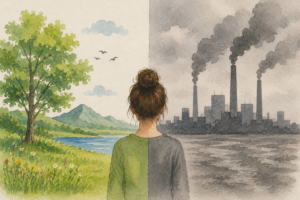
We have all experienced the frustration of having to deal with an overnight breakout. The immediate instinct is to grab your holy-grail serum that went viral on TikTok or a heavy-coverage concealer to conceal the blemish on your face. However, this periodic practice carries a huge environmental cost that isn’t often seen in our social media feeds, overshadowed by advertisements for new holy-grail products that catch your attention and eagerly await your purchase. The health of our skin and the health of our planet are intricately linked, and unfortunately, neither is functioning properly at the moment.
To illustrate this, the Earth can be equated to a living organism with pores represented by soil, oceans, and the atmosphere. Just as thick layers of grease, makeup, and synthetic silicones can accumulate on your skin and clog your pores, the overwhelming influx of unsustainable makeup products and their packaging is suffocating the global ecosystem. Ultimately, neither our pores nor the Earth’s can breathe fresh air, and we are essentially drowning in these harmful chemicals. According to the Plastic Pollution Coalition, the beauty industry produces over 120 billion units of packaging annually. A significant portion of this is not easily recyclable because of its extremely small size or the combination of different ingredients and materials. As a result, these billions of minute packaging materials and chemical formulas do not simply disappear or decompose; instead, they accumulate in landfills or float in our waterways. The formation of persistent layers of these spoilage that the planet cannot cleanse by itself is likely to provoke an uncontrollable breakout on the planet’s skin or the environment.
Beyond the readily visible waste from packaging these products, their chemical composition inflicts deeper environmental harm. When we cleanse our faces after a long day of wearing thick layers of makeup, those ingredients infiltrate our water systems and even evade the standard filtration processes because they are extremely minuscule, almost invisible. Numerous popular exfoliating scrubs and shimmering highlighters contain polyethylene, widely recognized as microplastics. These particles are too small for water filtration facilities to capture, allowing them to flow directly into the ocean, where marine organisms ingest them. Moreover, research on prevalent beauty products like acne ointments, dry shampoos, sunscreens, and deodorants has shown that certain formulations can break down into benzene, a type of carcinogen, when kept in warm conditions, which is closely linked to the cause of leukemia and blood disorders. As these chemicals are washed away, they disrupt the fragility of our local water ecosystems, ultimately poisoning and clogging the planet’s pores even more.
In addition, the physical packaging of these beauty products acts as a significant pollutant that worsens this global crisis. The recent trend of mini products, sample or travel-sized products, has intricate multi-layered packagings that generate a substantial amount of single-use waste. Common makeup product components like lipstick tubes or pump bottles often have a combination of plastic, metal, and glass, which are nearly impossible for local facilities to recycle. Consequently, every unboxing of layers of packaging in these beauty products denotes a new layer of harmful non-biodegradable plastic. It shapes what Earth’s natural ecosystems and organisms must contend with. This results in a tragic cycle where the industrial waste from these products increases air pollution, which is well known to provoke the very skin irritation and facial breakouts we were desperately trying to conceal.
Now, at this point of the reading, most readers may question whether the purpose of this article was to stop people from using makeup. Fortunately, we do not need to step away from makeup to adopt eco-friendly practices; rather, we should step even closer to makeup, but specifically towards the more sustainable yet realistic alternatives. Numerous well-known brands are already demonstrating eco-friendly practices, and our only job is to follow their intention to shape a new culture in the beauty industry.
For instance, Rare Beauty has committed to sustainability by using 100% recyclable packaging made from water-dissolvable protective foam, durable reusable cotton pouches, and actively incorporating more post-consumer recycled (PCR) plastics into its packaging since late 2021. Post-consumer Recycled (PCR) plastic is a material made from household waste like bottles that has been recycled, rather than virgin plastic, which helps reduce landfill waste and lowers carbon emissions. The use of PCR plastics has been rapidly increasing and is evident in many packaging for products like food, cosmetics, and paints.
Similarly, Lush has established itself as an impactful global leader in the beauty industry by creating “Naked” products, also known as packaging-free. These products include solid shampoo bars, bath bombs, and facial oil bars that require no packaging. Lush also offers Knot-Wraps, a great way to wrap their products as gifts. Made from organic cotton and two recycled plastic bottles, they are extremely friendly to the environment while serving their purpose of gift wrapping. Not only that, to encourage more people to pay attention to eco-friendly living, Lush also works to build a circular economy by allowing customers to return empty Lush bottles to the store for a discount on a free face mask. These programs ensure more words reach people and increase awareness of eco-friendly products.
Furthermore, other prominent brands are taking steps to create sustainable solutions available to a wider range of consumers. The Body Shop has introduced refill stations in hundreds of stores, allowing customers to purchase a single durable aluminum bottle and refill it indefinitely, thereby contributing to the circular economy in this industry. In addition to the convenience of refills, customers can save a lot of money while getting their products refilled, as they become more informed and aware of current environmental concerns.
These examples of brands’ efforts to sustain Earth’s ecosystems, in different ways, show that it is possible to uphold our daily beauty routines while working toward a cleaner planet. By embracing small discomforts in the shift in people’s daily lives and supporting brands that emphasize their efforts to make a positive impact on our environment, we allow both our skin and the Earth’s pores to breathe clear air.
Sources:
medium.com/marketing-in-the-age-of-digital/how-rare-beauty-selena-wins-the-internet-everyday-67121beac026. Accessed 17 Mar. 2026.
El Haddad, Claudia, et al. BMC Public Health, vol. 21, no. 1, 14 Sept. 2021, doi:10.1186/s12889-021-11738-0.
Dutchen, Stephanie. “How a Warming Climate Wears on the Skin.” Harvard Medicine Magazine, 3 Mar. 2025, magazine.hms.harvard.edu/articles/how-warming-climate-wears-skin. Accessed 17 Mar. 2026.
“Unexpected Benzene Levels in Popular Acne and Rosacea Products.” News, 8 Oct. 2024, www.news-medical.net/news/20241007/Unexpected-benzene-levels-in-popular-acne-and-rosacea-products.aspx. Accessed 17 Mar. 2026.
McPhillips, Kells. “Some Skin-Care Products Claim to Be ‘pollution-Fighting.’ Without These Ingredients, It’s Just Marketing.” Fortune, 2025, fortune.com/well/article/skincare-products-pollution-fighting-when-its-just-marketing/. Accessed 17 Mar. 2026.
US Department of Commerce, National Oceanic and Atmospheric Administration. “Sunscreen Chemicals and Coral Reefs.” Skincare Chemicals and Marine Life, 1 Nov. 2018, oceanservice.noaa.gov/news/sunscreen-corals.html. Accessed 17 Mar. 2026.
“Unexpected Benzene Levels in Popular Acne and Rosacea Products.” News, 8 Oct. 2024, www.news-medical.net/news/20241007/Unexpected-benzene-levels-in-popular-acne-and-rosacea-products.aspx. Accessed 17 Mar. 2026.
“Personal Care Products Archives.” Plastic Pollution Coalition, www.plasticpollutioncoalition.org/tag/personal-care-products#:~:text=The%20Ugly%20Side%20of%20Beauty,that%20needs%20to%20be%20addressed. Accessed 17 Mar. 2026.
US Department of Commerce, National Oceanic and Atmospheric Administration. “Sunscreen Chemicals and Coral Reefs.” Skincare Chemicals and Marine Life, 1 Nov. 2018, oceanservice.noaa.gov/news/sunscreen-corals.html#:~:text=Scientists%20have%20also%20discovered%20that,Coral:%20Accumulates%20in%20tissues. Accessed 17 Mar. 2026.
Boan, Daniel. “I Tried Lush’s New ‘naked’ Products That Have Zero Packaging – and They Totally Surprised Me.” Business Insider, www.businessinsider.com/lush-naked-packaging-free-products-review-2017-11. Accessed 17 Mar. 2026.
The views and opinions expressed are those of the authors and do not necessarily reflect nor represent the Earth Chronicles and its editorial board.