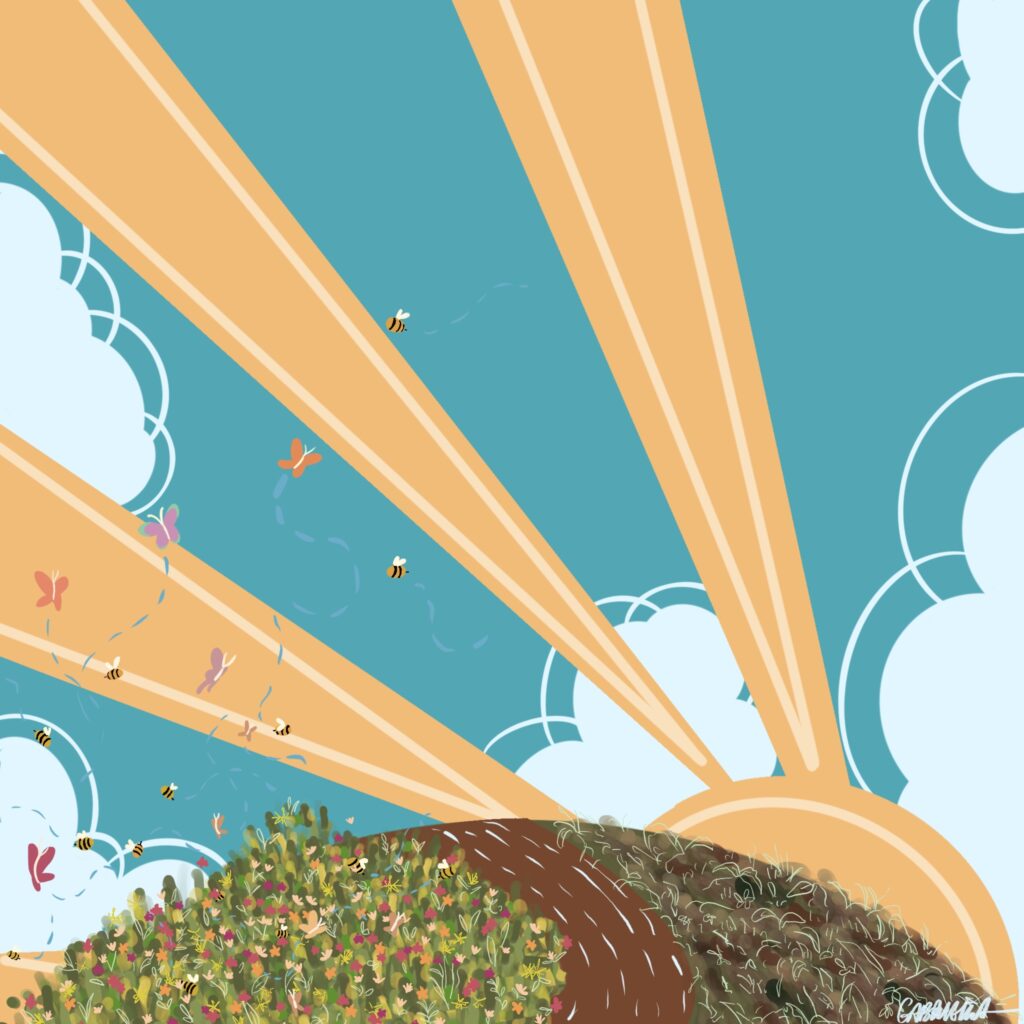
When you walk outside and see flowers blooming, everything looks normal. But something feels off. The colors are still here, yet the activity around them is fading. Pollinators are disappearing long before the flowers show any sign of trouble. It is a quiet shift that most people overlook.
Why This Matters
Pollinators are essential to ecosystems and food systems. More than three quarters of flowering plants depend on them to reproduce. These plants include wildflowers that protect soil and support wildlife. When pollinators decline these plants decline too, and the entire system becomes less stable.
The problem is already affecting farms. At Rutgers University, agricultural scientists found that many crops in the United States are showing signs of pollination shortages. Apples blueberries cherries squash and peppers are producing smaller harvests because their flowers do not receive enough bee visits. This is not a future risk. It is happening now.
Wild bees are especially important. They often pollinate crops more effectively than managed honey bees, but they are declining at the steepest rates. They are sensitive to habitat loss pesticides and climate change. When wild bees disappear there is no simple replacement. The system becomes weaker and less able to recover from stress.
The Environmental Protection Agency considers pollinator decline a serious environmental concern. Pollinators support plant diversity and help damaged areas grow back after storms or dry periods. Without them landscapes lose resilience and productivity.
What Is Driving the Decline
- Habitat loss — Urban development and large scale farming remove nesting sites and reduce the variety of flowers pollinators need. Some species depend on specific plants, so when those plants disappear the insects disappear too.
- Pesticides — Chemicals such as neonicotinoids harm bees by affecting memory navigation reproduction and immune systems.
- Climate change — Shifts in temperature and rainfall disrupt the timing of flowering. Flowers may bloom earlier while pollinators emerge later which puts them out of sync.
- Disease and parasites — Stressed pollinator populations are more vulnerable to pathogens and parasites which makes the decline worse.
Act Now
Planting native flowers is one of the simplest ways to help. Native plants provide the food and shelter pollinators evolved with. Even a small patch can support bees butterflies and other insects.
Avoiding pesticides is also important. Many garden chemicals can weaken or kill pollinators especially when they are already stressed by habitat loss and climate change.
Communities can protect open spaces and support farms that use pollinator friendly practices. Schools and parks can create pollinator gardens. Cities can reduce mowing and allow wildflowers to grow in unused areas. Small actions add up and help rebuild habitats.
People can also support policies that protect pollinators. This includes limits on harmful pesticides conservation programs and more funding for research. Scientists are studying how to restore pollinator populations but they need public support to turn research into action.
Awareness matters. Once people understand what is happening they start to notice the quiet changes around them. They see fewer bees on flowers. They hear less buzzing in the summer. The silence becomes a warning.
Acting now means choosing to protect the systems that feed us and keep ecosystems alive. Pollinators are disappearing but the story is not finished. There is still time to change the outcome if we pay attention and take responsibility.
Cited Works
- Bates, Todd. “Decline of Bees, Other Pollinators Threatens U.S. Crop Yields.” Www.rutgers.edu, 29 July 2020, www.rutgers.edu/news/decline-bees-other-pollinators-threatens-us-crop-yields.
- US EPA,OCSPP. “Pollinator Protection | US EPA.” US EPA, 25 Apr. 2019, www.epa.gov/pollinator-protection.
- Kudo, Gaku, and Elisabeth J. Cooper. “When Spring Ephemerals Fail to Meet Pollinators: Mechanism of Phenological Mismatch and Its Impact on Plant Reproduction.” Proceedings of the Royal Society B: Biological Sciences, vol. 286, no. 1904, 12 June 2019, p. 20190573, https://doi.org/10.1098/rspb.2019.0573.
The views and opinions expressed are those of the authors and do not necessarily reflect nor represent the Earth Chronicles and its editorial board.