“Looking for the newest trendy clothing piece? Can’t stop thinking about that Labubu you saw on TikTok Shop? For most Americans, convenience and affordability are the main factors that shape the decision to make a purchase. So instead of buying higher-quality items that are more expensive and may take weeks to ship, consumers turn to places like Shein and Amazon: mass good production outlets that guarantee fast shipping and come with little cost to the buyer.
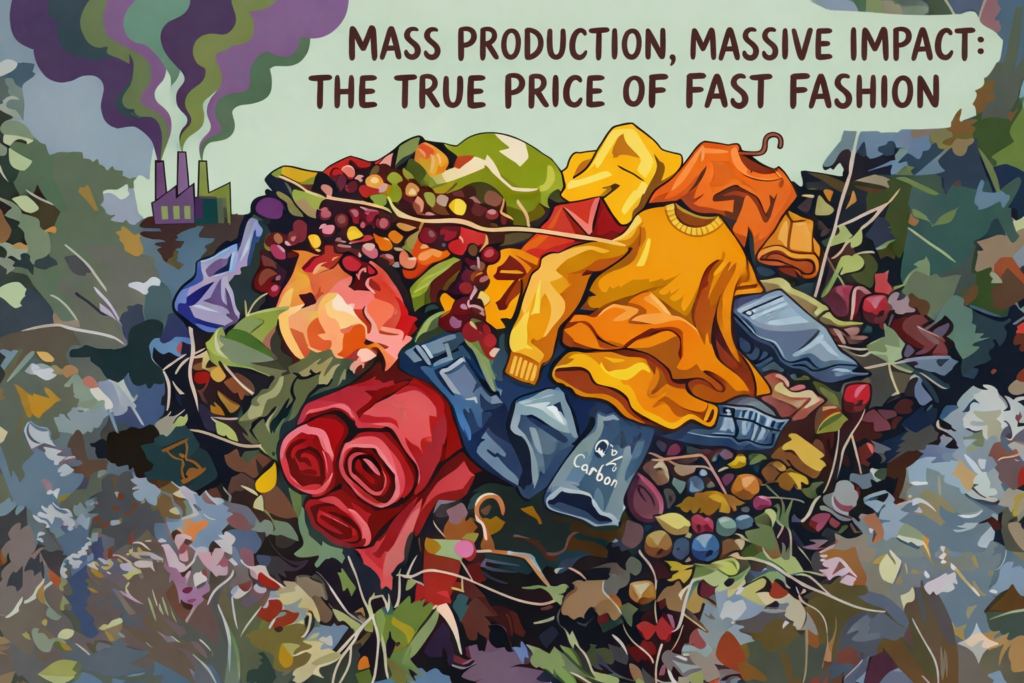
Although these low-quality goods may come at a much smaller monetary cost to the buyer than the higher-quality alternatives, the real price is far greater than most can imagine. Fast fashion is responsible for 10% of total global carbon emissions, making it one of the main causes of our globe’s pollution crisis. Some of the main contributors to the industry’s global pollution impacts are dyeing and finishing (36%), yarn preparation (28%) and fibre production (15%). And even though all of this energy is spent producing fast fashion, 85% of textiles still end up discarded in landfills. This is due to both the low quality and cheap materials used to produce the goods, and the overproduction of goods by companies that exceeds the speculated demand. And in the upcoming years, these numbers are only projected to increase.
Mass-produced goods come at a heavy cost to not only the environment, but our own health and well-being. The production of certain types of materials can release harmful chemicals and microplastics, contaminating our water sources. Besides the human harm that comes to the buyer, the workers that produce these goods are also facing harmful conditions. In order to continue cheaply producing these goods, inexpensive labor is needed. Goods are often produced in countries like China or Bangladesh, where labor costs are lower. Workers spend long hours in factories with little safety procedures and exposure to toxic dyes, including azo dyes that release carcinogenic aromatic amines linked to cancer and other health risks.
So what can we do?
The “slow” fashion movement arose as a reaction to fast fashion, pushing for environmental and social justice in the fashion industry and fighting back against overproduction and overconsumption. It prioritizes quality over quantity, an environmentally-friendly production process, safer conditions for workers, upcycling, and not producing stock in small batches to avoid excess materials. Many customers still don’t know the waste that comes with fast fashion. By spreading the message of the slow fashion movement, we can inform and encourage more sustainable and humane shopping habits.
Other ways to avoid supporting mass production and fast fashion include investing in longer-lasting, quality products. Thrifting at thrift and vintage stores is a newly popularized method of shopping for second-hand goods without breaking one’s budget. There are also many convenient, online second-hand stores, including Depop, eBay, and ThreadUp. Both of these methods encourage the upcycling of existing goods, rather than encouraging the widespread production of new ones.
As more people become aware of the environmental and social costs of mass production, more questions arise about the ethics of buying from brands that are known for mass production. But to see real change, we must be able to prioritize the future by investing in products that last longer and fighting for the future of our planet.
The views and opinions expressed are those of the authors and do not necessarily reflect nor represent the Earth Chronicles and its editorial board.