Illustrated by Julianne Park. All rights reserved.
The Reality of Recycling and the Problems with Single-Stream Systems
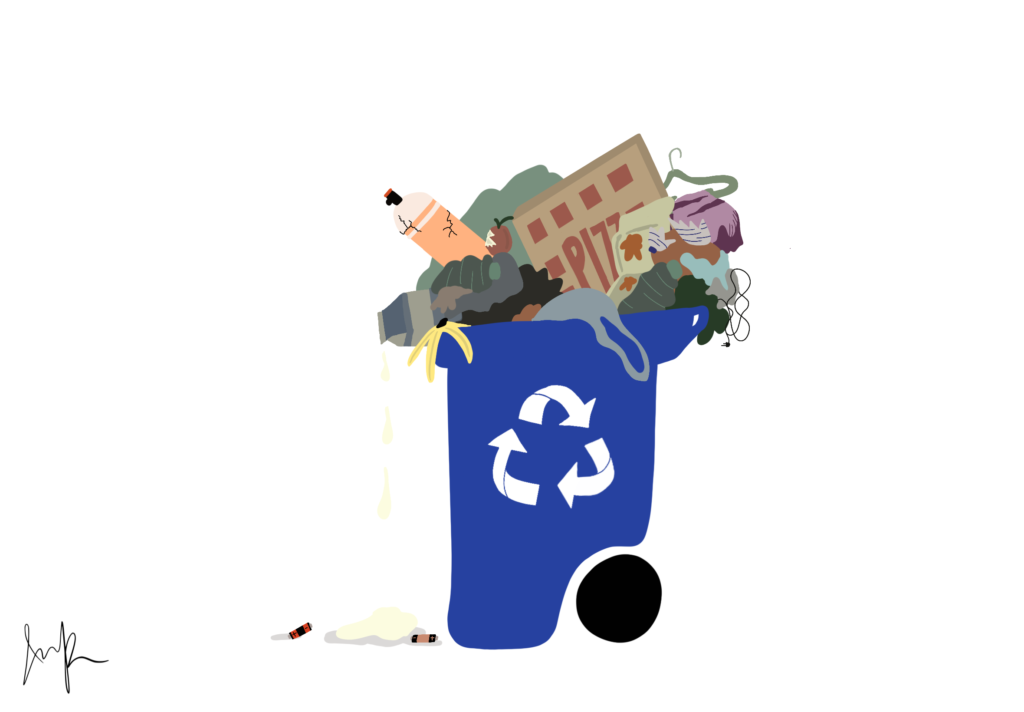
Every week, you dump your proud recycling collection into the blue bin. You set the bin out on the curb. You go to bed feeling full-filled because you did your part to prevent waste from piling up in the landfills and contribute to a more sustainable lifestyle.
Here’s where I tell you that’s not exactly the case.
Recycling is a crucial step to reducing our waste. However, according to Laura parker from the National Geographic, 91% of our plastic isn’t even recycled. Only 9% ends up being recycled (Parker, 2021). The inefficiency and futility of setting up blue bins for waste that never gets recycled must be changed.
And one of the major contributing factors of ineffective recycling is single-stream recycling.
Problems with Single-Stream Recycling
Single-stream recycling is where all recyclable materials are collected in a single bin. Later, it is sorted at a materials recovery facility (MRF).
While this approach may be convenient at the consumer level, it creates several problems:
1) More of the recyclables end up in landfills.
2) Increased contamination and large amounts of waste end up broken.
3) The cost to process is higher because they must go through the extra step to be sorted and transported.
4) The recyclable items processed are of poorer quality (usually end up in landfills) (Brimmo, 2019).
Although recycling rates are increasing, how many items we put in blue bins every week are really being recycled?
Still confused? Let’s look at it this way.
Contamination and Consumer Behavior
Have you ever finished your lunch in a recyclable plastic container and then put it in the recycling? Well, that’s one reason why recycling has become ineffective. Food residue on plastic will lead to contamination of the entire bin. Contamination is one of the most common reasons recyclable materials are rejected. Let’s look at another example. Maybe you just finished a beer bottle or a soda in a glass bottle. Throwing these into the recycling bin may break the glass. Broken glass can contaminate cardboard, paper, and other recyclables. It can inhibit the recycling process for not only that broken glass but also the other items in the bin.
We’re all guilty of this, and here are some ways we can fix this.
1) Check if the container is recyclable.
2) If it is, wash the container and dry it.
3) Then, put it in the blue bin.
Alternatives to Single-Stream Recycling
There are alternatives to single-stream recycling. For example, dual-stream and multi-stream recycling have increased efficiency than single-stream.
Multi-stream recycling involves sorting the recyclables into different categories by the consumers rather than the MSR. There are many benefits to this system.
1) Non-recyclable items will stop entering recycling systems.
2) A higher percentage of recycled items will actually be recycled.
3) Less contamination.
4) Lower costs (Brimmo, 2019).
The more sorting the citizens do, the less money, energy, and time it takes to recycle. It’s also important to recycle educatedly.
Aspirational Recycling and Its Consequences
Aspirational recycling or wish cycling is when you “feel” like something is recyclable so you put it in the blue bin. You do not know whether or not it is recyclable. However, you assume that whatever is not recyclable will be sorted out by the MSR. Unfortunately, this is devastating to the ultimate goal of recycling. A single misplaced item can lead to contamination and other impediments, resulting in the removal of the entire load (Rubicon, 2022).
Here are some things you can do to increase recycling efficiency and reduce waste production.
- Reach out to your local governments. Propose to them a more sustainable alternative to single-stream.
- Educate yourself. Our recycling problems stem from our lack of knowledge on what can get recycled and what can’t. Click on our Take Action page and look at the recycling guides provided. When in doubt, never “wish-cycle!” Just take a minute to check whether that object really belongs in the blue bin.
References
Brimmo, A. (2019, February 18). Single vs. multiple stream recycling. Cycled. https://cycled.no/single-vs-multiple-stream-recycling/
Parker, L. (2021, May 3). A whopping 91% of plastic isn’t recycled. National Geographic. https://www.nationalgeographic.com/science/article/plastic-produced-recycling-waste-ocean-trash-debris-environment
Rubicon. (2022, July 8). The waste of aspirational recycling. https://www.rubicon.com/blog/aspirational-recycling/
The views and opinions expressed are those of the authors and do not necessarily reflect nor represent the Earth Chronicles and its editorial board.