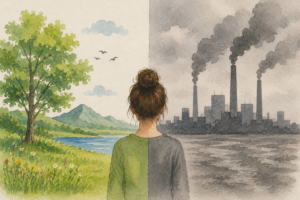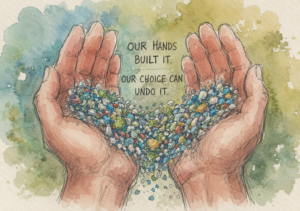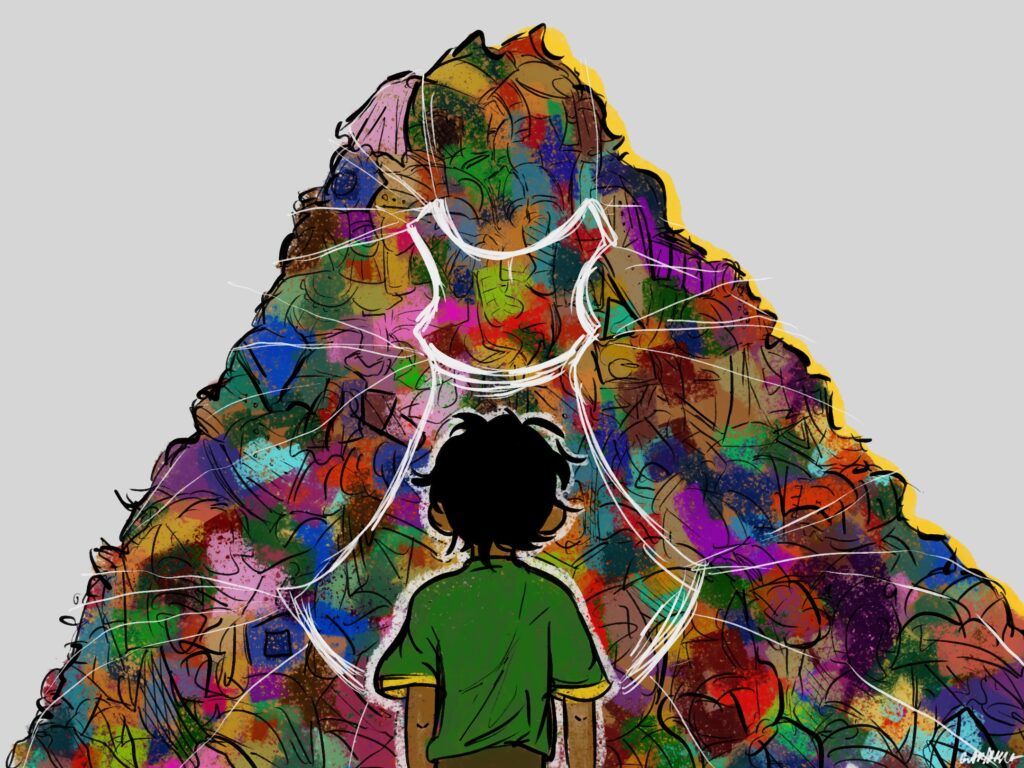
Every year, over 92 million tons of clothes end up in landfills. This is equivalent to 2.3 million heavy-duty dump trucks filled with textile waste. The worst part is that 65% of modern garments are mainly made up of synthetic fibers such as polyester and nylon, which aren’t biodegradable. Clothes that aren’t biodegradable never completely break down. They stay unused and potentially travel through ecosystems for centuries. This is a vast problem for the Earth and all its inhabitants. We know pollution affects wildlife and ecosystems, but how does it affect humans?
To understand how we got here, it is crucial to look at how clothing has evolved over time. From simple cotton garments to Baroque silk and velvet gowns, styles and fabrics have changed a lot. Before synthetic fibers came into play, most clothing was made up of animal and plant-based materials: silk, leather, wool, cotton, linen, and other biodegradables. We don’t have many outfits from ancient Egypt, Greece, or China because all their garments were made from natural materials that would have eventually broken down and been recycled by the ecosystem over time. Now imagine if people back then wore clothes made of polyester and nylon. What would it have taken to recycle those fibers? Would our society still look the same?
Fast-fashion is not always glamorous. Sure, you may get a bunch of cute and cheap clothes, but quality deteriorates fast, and the trend fades after a couple wears. These castoffs end up in landfills or get shipped to countries that can’t afford first-hand clothes. This, in theory, sounds great because your donated clothes are helping someone else, but the truth is that many of these countries—such as Chile, Kenya, and Bangladesh—are getting overflooded with tons of textile waste. Less than 50% of the 2-4 million metric tons of clothing these countries get can be sold. The unsold clothes get thrown out when new shipments arrive, causing problems such as clogged drainage and health issues. Imagine if you were in this situation where, as soon as you stepped outside your house, there were piles of damaged and abandoned clothes around every corner. This is the reality for many people.
However, the problem doesn’t always stem from over-production of clothes, rather the materials used to create them. Natural wool and leather, which are primarily used in cozy sweaters and stylish jeans, tend to break down easily; but synthetic polyester and spandex used in athletic clothing don’t break down. Why is this? The simple answer is chemistry. The chemical structure of plastics like synthetic fibers are more complex than natural materials. They are built to be strong and durable, making them challenging to break down. Microorganisms responsible for decomposing fibers don’t have the required enzymes to break down complex structures. Even when plastics get broken down, they never fully decay. Small microplastics are left behind, causing more damage than their bigger counterparts.
Thankfully, people are working to address and solve the issue of textile waste. Among these innovators is the founder of Evrnu®, Stacy Flynn. Ironically, Stacy started out by working in the fast fashion industry. Her perspective changed when she visited China on a work trip and learned how mass-produced clothes were created. Typically, manufactured clothing moves through markdowns like outlet stores or liquidators, but can also be donated to charities, recycled into raw materials, repurposed, or, as a last resort, destroyed. Realizing that she didn’t want to contribute to excessive textile waste, Stacy created Evrnu® and developed a process to take old fabrics and recycle them through Nucycl® ‘s process. Using a proprietary closed-loop chemical process, Nucycl® converts cotton and cotton poly blends into fresh fabric by separating and rearranging chemical bonds. Now many of you may be wondering: why would people wear clothes made up of fabrics that could have ended up in landfills? Lyocell, the fabric created from Nucycl®’s process, is antibacterial, durable, soft, and luxurious like silk.
Another champion of this issue is Dame Ellen MacArthur, who developed the core idea of a circular economy after her record-breaking 2005 solo-sailing journey around the world. After retiring from professional sailing, she founded the Ellen MacArthur Foundation in 2010 to promote a more circular economy, shifting from a “take-make-dispose” model to one that designs out waste and regenerates nature. The basic idea for a sustainable circular economy is that every material goes through its circle of life: accumulating raw materials, design, production, retail, consumption, reuse, collection, and finally recycling. This is how the model should work. However, new synthetic materials that don’t decompose break this chain. This then contributes to an array of problems including economic loss, geopolitical tension, climate change, pollution, and toxicity.
How would addressing textile waste benefit the future? The answer to this question varies based on your perspective of the issue, but to summarize, there is no clean future if this continues to advance. The fashion industry is responsible for a lot of global waste, precisely 11% of plastic pollution, 20% of water consumption, and 35% of marine microplastic creation. When used excessively, synthetic fibers cause plenty of health concerns including irritation to the eyes, skin, and the respiratory system—eventually leading to serious health concerns like cancer. Are you wondering if there is still time to fix this in the future? It is predicted that the fashion industry’s production of textile waste is on track to increase 50% by 2030. That’s only 4 years away and if we don’t act fast now, our future is in danger.
Luckily, there are ways to turn back time and reduce textile waste. In the US, eventually 80% of clothes end up in landfill. People tend to only donate wearable clothes they imagine will be used by others. One way to help solve the textile waste problem is to donate all your unwanted clothes, regardless of condition. Donated clothes eventually get sent to companies like Evrnu® or go to recycling plants. Another way to help is by thrifting, which is shopping for used clothes at places like the Goodwill. By reusing clothes instead of buying new ones, textile waste is reduced. Also, using clothes made of natural materials not only benefits your skin, but also the environment. To know exactly what your clothing is made of, check the label inside of the garment. Wearing your clothes and having a sustainable, minimalist closet is another huge help. The term “European closet” refers to having basic staples like a plain white shirt, denim jacket, and a black dress, which you can style differently every time you go out. This is a classic way of reducing the amount of clothing bought each year, which is around $500 billion annually. Finally, you can buy clothes made from recycled fabrics from brands like Evrnu®. Evrnu’s goal is for all textiles to become recyclable by 2030 and to create a net neutral industry by 2050.
By changing a few simple habits and reshaping our closets, we can protect our planet from being covered in textile waste, securing a clean future for generations to come. The next time you’re shopping, consider buying a garment that helps to achieve this goal. Textile waste is not an environmental issue; it is a human one.
Works Cited
Evrnu® – a recycling textile supplier with a social purpose, https://www.evrnu.com/. Accessed 21 December 2025.
“The Age of Plastic: From Parkesine to pollution.” Science Museum, 11 October 2019, https://www.sciencemuseum.org.uk/objects-and-stories/chemistry/age-plastic-parkesine-pollution. Accessed 21 December 2025.
“The Circular Economy | Definition & Model Explained.” Ellen MacArthur Foundation, https://www.ellenmacarthurfoundation.org/topics/circular-economy-introduction/overview. Accessed 21 December 2025.
“The Clothing Waste Crisis: How Our Shopping Habits Are Hurting the Planet | NBCLX.” YouTube, 24 January 2020, https://www.youtube.com/watch?v=Bhi7S06pwv4. Accessed 21 December 2025.
“Ellen MacArthur – Agenda Contributor | World Economic Forum.” The World Economic Forum, https://www.weforum.org/stories/authors/ellen-macarthur/. Accessed 21 December 2025.
“Ellen MacArthur: The Circular Economy Visionary Rethinking Sustainabil.” Grow Billion Trees, 14 December 2025, https://growbilliontrees.com/blogs/inspirational-stories/ellen-macarthur-the-circular-economy-visionary-rethinking-sustainability. Accessed 21 December 2025.
“Environmental Sustainability in the Fashion Industry – Geneva Environment Network.” Geneva Environment Network, 17 November 2025, https://www.genevaenvironmentnetwork.org/resources/updates/sustainable-fashion/#. Accessed 21 December 2025.
Igini, Martina. “10 Concerning Fast Fashion Waste Statistics.” Earth.Org, https://earth.org/statistics-about-fast-fashion-waste/. Accessed 21 December 2025.
Monroe, Kristian. “Anxious over clothing costs, some shoppers turn to renting.” NPR, 13 November 2025, https://www.npr.org/2025/11/13/nx-s1-5601751/clothing-rentals-on-the-rise-as-shoppers-and-retailers-brace-for-tariffs-impact. Accessed 21 December 2025.
Ryssdal, Kai, and Livi Burdette. “What would a world without plastic look like?” Marketplace, 3 December 2025, https://www.marketplace.org/story/2025/12/03/a-world-without-plastic. Accessed 21 December 2025.
Seattle fashion collective. “Stacy Flynn.” The designer series, 2025, https://seattlefashioncollective.com/the-designer-series-stacy-flynn. Accessed 21 December 2025.
The views and opinions expressed are those of the authors and do not necessarily reflect nor represent the Earth Chronicles and its editorial board.