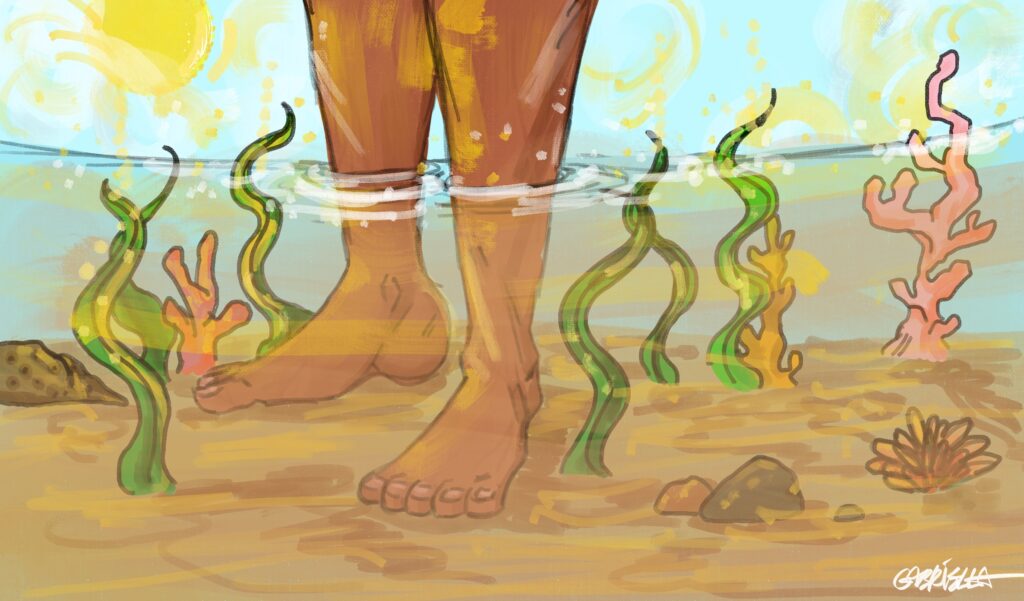
The sun came up over Terang Bay orange, then a bruised violet, and the water underneath it was doing something it hadn’t done in Amara Sutrisno’s lifetime. Breathing again, sort of. That was the word she used, anyway, when she couldn’t be bothered explaining dissolved oxygen curves to people who just wanted to know if the fish were coming back.
She was up on the new seawall’s bamboo scaffold, one hand on a sensor pod about the size of a coconut, its skin dotted with solar cells no bigger than a fingernail clipping. Below her the kelp swayed in loose brown ribbons, tied off to lines her grandmother used to use for something completely different — she could never remember what, exactly. Squid, maybe.
“You’re up early.” Nenek Wati was climbing the ladder slower than she used to, though God help you if you tried to help her up it. Same flick of the wrist she’d been giving Amara since Amara was six.
“Couldn’t sleep. Array finished its overnight sync.” Amara tapped the pod and a blue light blinked twice, then held. “Water’s down half a degree from last month. Oxygen’s up. Kelp’s growing faster than the models said it would.”
Her grandmother didn’t say anything for a second, just looked out at the dark lines of kelp threading between old fishing buoys somebody had repurposed as anchors. Thirty years back this water had been a graveyard — bleached coral, dead zones, two separate stock collapses inside Wati’s own memory. She’d told Amara more than once she never thought she’d see it come back like this. Not in her lifetime.
“When I was your age we thought the ocean was too big to break,” she said. “Then we thought it was too broken to fix. Both wrong.”
Ten years before this, Terang Bay was the kind of town people left. The cooperative was down to a handful of tired boats. The reef that used to pull snorkelers in from across the strait was a field of gray rubble. Anyone young enough to go somewhere else, went.
Amara left too — three hundred kilometers north, marine engineering, lecture halls that smelled like recycled air. It was there, half-asleep in a seminar on environmental sensing nobody else seemed excited about, that she first heard about a project out of a university lab: cheap, biodegradable ocean sensors, built so small coastal towns could monitor their own water without waiting on anyone else to do it for them. She wrote to the lab. Twice. Got a reply the second time.
She came home with a grant, forty sensor pods, and an idea most of her old neighbors thought was a little unhinged.
“You want to grow seaweed to fix the ocean,” her cousin Rizal said over coffee her first week back. Not mean about it. Just — skeptical. “The same ocean that took three of our boats.”
“Kelp pulls carbon out faster than most forests on land,” she told him, probably too fast, the way she always talked when she cared about something. “It slows the waves down so the coast stops eroding as bad. It eats up the nitrogen that’s been choking everything, and it gives the fish somewhere to hide. It’s not going to fix it by itself. But it’s something to build the rest on.”
It took two years to get even a hundred meters of kelp line to actually hold. First batch died — wrong species for the water temp. Second batch got torn out in a storm. Third batch mostly survived a heatwave that killed everything around it, which felt like a miracle until Amara realized it was mostly luck. She nearly quit more than once.
What kept it going wasn’t the sensors. It was Wati, who remembered which stretches of the bay used to be thick with fish and steered Amara toward currents no map showed. It was Rizal, welding scrap into anchor frames whenever the money ran out. It was a rotating crew of teenagers who showed up for the stipend and, somewhere along the way, stayed for reasons they didn’t really talk about.
By year four the sensors were feeding a dashboard anyone in town could pull up on their phone — water quality, fish counts the fishers logged themselves, how fast the kelp was spreading. By year six three other bay towns had asked how to copy it, and were already changing it to fit their own water before Amara had finished explaining the first version.
If you asked her what made it work — and people did ask, eventually, once word got around — she’d tell you it wasn’t any one thing. The sensors were cheap because they were built to be cheap, out of parts any electronics shop already had, with instructions simple enough that a teenager could fix one with a soldering iron and a bad attitude. Half the restoration methods came from Wati’s generation, not any textbook — planting on the lunar cycle, when the current carried less sediment, weaving anchor lines a certain way that outlasted the store-bought kind by years. The solar microgrid running half the village now got paid for through a community fund, households chipping in what they could and getting paid back in electricity credits, which was really just an old system of pooling resources that had never actually gone anywhere, just gotten forgotten.
Even the seawall she was standing on was something the engineering world was only just starting to take seriously — mycelium composite, grown instead of poured, fed on farm waste that used to just get burned in the fields. It locked carbon in instead of putting it out. Cost less than concrete. And when a storm knocked out a section, they grew a new one in the old rice-drying shed instead of waiting three months for a barge from the mainland.
None of it, she’d say, had been her idea alone, and she meant it, though she suspected people didn’t always believe her. It was the part she tried hardest to get across whenever a journalist showed up — which happened now, occasionally, drawn by the odd sight of a fishing town with a coral nursery and a live-updating recovery dashboard.
“People want to know what piece of technology saved this town,” she told one, walking the reef site where a couple of local divers were tying lab-grown coral fragments onto the old rubble. “But none of it — the sensors, the panels, any of it — means much without people actually willing to change how they live around it. My grandmother’s generation knew this water better than any of us ever will. My generation just had tools they didn’t have. It worked because those two things ran into each other. Not because one replaced the other.”
The reporter asked what was next.
Amara looked out — fishers checking nets in water with more life in it every season, kelp lines doing double duty as informal sea cucumber farms, rooftops covered in panels that had made electricity bills basically disappear, a school where kids read sensor graphs before they’d finished long division.
“Teach it,” she said. “Not the tech part, that travels fine on its own. The hard part’s convincing people they don’t have to wait around for someone else to come fix what’s broken where they live. That it’s cheap now. That they already know most of what they need to.”
That evening she sat with Wati on the porch watching the lights come on across the bay, small and solar-fed and steady. A boat was coming in past the reef, sitting lower in the water than it would’ve a decade ago, which meant a heavier catch, which meant something good.
“You know,” Wati said, “when you came back with your sensors and all that talk about carbon, I figured you’d gotten your grandfather’s stubbornness and none of his patience.”
“So which one changed your mind?”
“Neither.” Wati smiled, in the way she did that made the lines around her eyes go deep. “Turned out you didn’t need patience. You needed the rest of us to remember we still had something worth offering. That was the piece that was missing. Not the machines.”
Amara sat with that for a while after her grandmother went in. Thought about the hundreds of towns like this one scattered up and down coastlines everywhere, each one working through some version of the same realization — that fixing things was never going to come down to one big invention arriving to save everyone at once. It was smaller than that. Slower. A lot of little partnerships between what people already knew and what they’d only just gotten their hands on, copied and bent and made local, over and over.
The future wasn’t going to show up as some gleaming city on a hill or a headline everyone remembered where they were when they read it. It was going to look more like the kelp forest — stubborn, uneven, held together by lines that somebody kept checking and re-tying because they’d decided it mattered enough to bother.
Out past the reef, the sensor pods kept blinking their small blue light into the dark. Patient in the way tide pools are patient. In the way anything is, once it’s finally been given room to grow back.
The views and opinions expressed are those of the authors and do not necessarily reflect nor represent the Earth Chronicles and its editorial board.


Comments are closed.