When 18-year-old Emma Collins arrived at her university dormitory in Vancouver, her mind was racing with worries about whether she would get along with the stranger she would be sharing a room with for the next eight months. All Emma had ever known was the busy streets of Vancouver. On weekends, she’d walk the waterfront and complain about the endless autumn rain. Her biggest adversaries were crowded buses, overpriced coffee, and the occasional power outage that forced her to endure the horrifying experience of being offline for more than ten minutes.
The very idea of going without clean running water, electricity, or a safe place to sleep was inconceivable. To Emma, these were things that had always been there and always would be.
Emma was ready for a fresh start, unaware that the girl she was about to meet would have gladly traded her entire future for a chance to return to her past.
Her roommate, 19-year-old Maya Bennett, arrived nearly an hour later, dragging one battered suitcase behind her. A faded green backpack hung loosely from one shoulder, and a flimsy cardboard box sat tucked under her arm. While Emma had spent the better part of the morning making three trips from her parents’ car, Maya managed to carry everything in a single trip.
Emma glanced at Maya’s belongings, then at the mountain of her clothes, throw pillows, skincare products, and decorations covering her own bed.
“Is that everything?” she asked.
“Pretty much,” Maya replied, brushing a loose strand of hair behind her ear.
Emma laughed. “I brought six bags, and that’s not even counting the stuff my mom’s bringing next weekend. She said I packed like I was moving across the world.”
Maya managed a shy smile: “Guess I’m just a light packer.”
Emma grinned. “Clearly. You’re going to have to teach me your ways.”
Emma assumed her new roommate was a minimalist. It never occurred to her that Maya hadn’t chosen to own so little.
Four years earlier, Maya had lived in Lytton, a small community in interior British Columbia at the confluence of the Fraser and Thompson Rivers. She remembered the majestic mountains, how their peaks disappeared into the silvery morning mist, and the earthy scent of pine trees whenever the wind swept the valley.
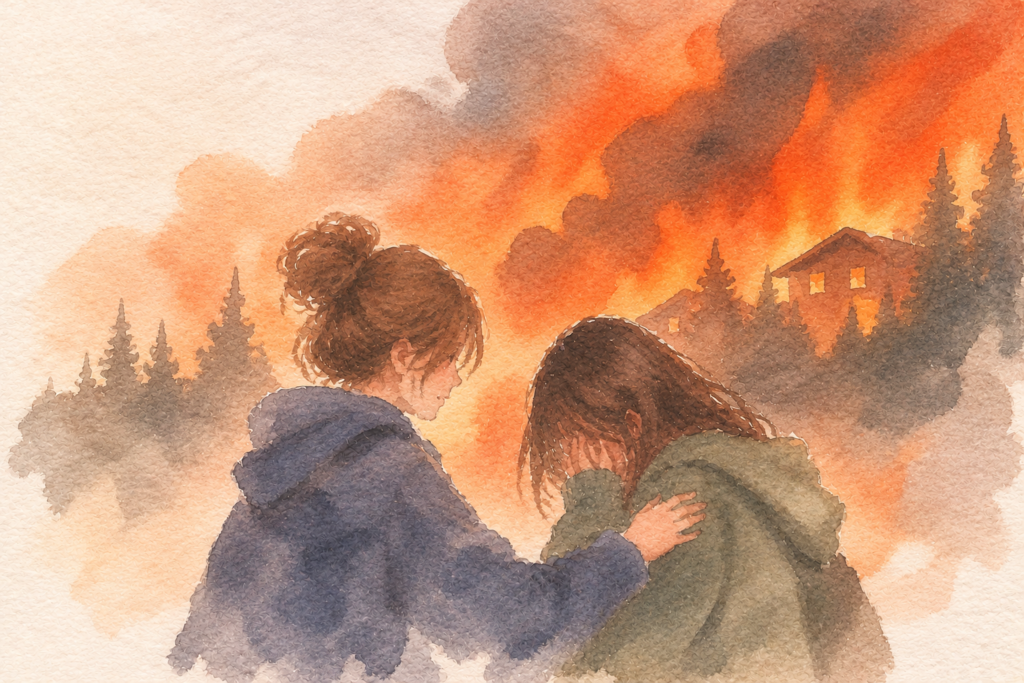
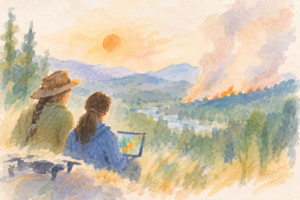
On June 30, 2021, a devastating conflagration ravaged Lytton. Within minutes, thick clouds of acrid smoke swallowed the sky as merciless flames devoured everything in their path. By the time the ferocious fire set to ash, hundreds of residents had lost their homes, and two had even lost their lives.
Maya was 14 at the time. Through hazy memories, she’d recall her father shouting for everyone to evacuate. As they drove off, the orange-stained sky, the smoke too noxious to breathe, and the desperate cries of fleeing neighbors were all swallowed by the night.
For months afterward, Maya’s family bounced between cramped motels and emergency shelters, never staying anywhere long enough to unpack the single battered suitcase containing remnants of their former lives. Her parents spent hours hunched over insurance forms, trying to piece together a life that was no more. Her father, who had spent nearly 15 years managing Lytton’s most successful restaurant, suddenly found himself unemployed. Her mother, once full of conversation, retreated into her shell. Whenever another wildfire popped up on the evening news, she would immediately reach for the remote to power it down.
When Maya received her university acceptance letter, her parents encouraged her to seize the opportunity, reminding her that the financial aid would cover most of her expenses and give her a chance to live the life of a normal college girl. But moving hundreds of miles away from the charred remains of her hometown didn’t make Maya any less scarred.
The first dispute erupted on a Tuesday morning. Maya walked into the bathroom to discover Emma brushing her teeth with the faucet running.
“Could you turn the water off?” Maya asked.
Emma scowled. “I’m literally brushing my teeth.”
“But you’re not using it.”
An annoyed Emma turned the tap off. “It’s just water, Maya.”
Maya’s chest tightened as she stared down at the sink.
Over the next two weeks, Emma began noticing more of Maya’s idiosyncratic habits. She unplugged chargers as soon as they weren’t being used, switched off lights the minute someone left the room, and saved even the smallest portions of leftover food. One chilly evening, Emma returned from class to find that Maya had powered down their electric heater.
“Why is it freezing in here?” Emma barked.
“The heater was running while nobody was home,” Maya clarified.
“Um…maybe because it’s cold outside!”
“That’s what blankets are for.”
Emma dropped her backpack onto the floor and scoffed.
“Why do you act like we’re going to run out of everything?”
To her, Maya’s behavior seemed excessive and unnecessary. After all, electricity came from outlets, water flowed from faucets, and food was just two blocks away at the grocery store. Emma had never contemplated what life would be like without those comforts. One afternoon, Emma introduced Maya to her friends over lunch.
“So, you’re from Lytton?” one asked.
Maya nodded.
“Wait, isn’t that the town that burned down?”
“Yeah,” Maya replied abashedly.
“Oh my God, I remember seeing that on TV!” another exclaimed. “Well, at least you’re in Vancouver now. There’s way more to do here anyway.”
Emma chuckled, but Maya only pushed her foot around her plate.
After what seemed like an eternity of awkward silence back at the dorm, Emma blurted, “What’s your damage? They were just trying to make conversation.”
Maya’s jaw tightened: “They talked about my hometown like it was some worthless place I should be happy to escape from.”
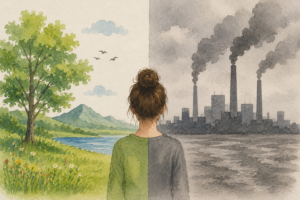
For the first time, Emma realized that Vancouver and Lytton were much more distant than she had presumed, and not in terms of geography. She and Maya grew up in the same province, spoke the same language, and now shared a room barely big enough for two beds. But somehow, they might as well have grown up on different planets.
The rain had been falling for days, and one Thursday night in October, the dorm’s fire alarm began screaming.
Emma groaned and rolled over.
“Seriously? Another stupid drill?”
But Maya was already standing, her breaths growing shallow. Her hands shook as she frantically searched for her shoes.
“We need to go,” she insisted.
Emma reached for her jacket.
“Relax. It’s probably someone burning popcorn.”
“EMMA, GET UP!”
Maya grabbed her backpack and within seconds was out the door, leaving her phone behind. Emma followed her into the hallway, where students slowly made their way toward the exit.
Outside, rain soaked through their pajamas as they waited for campus security.
Maya stood aloof from the others, trembling uncontrollably.
Emma approached her.
“Hey. Don’t worry, it’s going to be okay.”
Maya shook her head.
“You don’t understand.”
“Talk to me.”
Maya stared at the building, eyes wide with a terror she knew all too well.
“When we evacuated Lytton, my dad told me we’d be back the next morning,” she confided. “He said everything would be fine.”
Her eyes glistened with tears.
“We never went back home. It was gone. Our bedrooms, our clothes, generations of family heirlooms. Everything.”
Emma fell silent.
“Every time I hear an alarm, it feels like it’s happening all over again. Every time I smell even the faintest bit of smoke, I think someone’s going to die, or I might lose everything again.”
Emma finally understood that the habits she’d judged were Maya’s way of regaining control.
“I’m sorry,” Emma said contritely. “I kept acting like you were causing issues.”
Maya wiped her cheeks. Although the alarm turned out to be nothing more than smoke from an overheated appliance and nobody was injured, something between the roommates had changed.
The next morning, Emma turned off the faucet while brushing her teeth. Maya noticed but said nothing.
A few days later, Emma asked Maya to tell her about Lytton before the fire. Maya browsed the internet for photos of rivers and hillsides, of busy streets and bustling shops. For the first time, Emma saw Lytton as more than a tragedy. It had been a home.
One evening, Emma and Maya sat beside their dorm window, watching the rain blanket Vancouver.
“Do you think you’ll ever move back?” Emma asked.
Maya considered the question.
“I don’t know if there’s anything for me to move back to.”
In that moment, Emma finally understood that even when the flames are extinguished and the embers are long gone, some scars never truly fade.
But sometimes, acknowledging those wounds is the most important step toward healing them.
Works Cited
“Five Years After the Lytton Creek Fire.” CBC News, 28 June 2026, https://www.cbc.ca/news/canada/british-columbia/five-years-lytton-creek-fire-9.7250681.
Office of the Auditor General of British Columbia. “Provincial Support for the Village of Lytton’s Wildfire Recovery.” Office of the Auditor General B.C., 17 Mar. 2026, https://www.oag.bc.ca/provincial-support-for-the-village-of-lyttons-recovery/.
Young, Michael. “Canada Wildfire: The Lytton Tragedy and the Growing List of Surprise Wildfires.” Moody’s, 22 Nov. 2021, https://www.moodys.com/web/en/us/insights/insurance/canada-wildfire-the-lytton-tragedy-and-the-growing-list-of-surprise-wildfires.html.
The views and opinions expressed are those of the authors and do not necessarily reflect nor represent the Earth Chronicles and its editorial board.

Comments are closed.