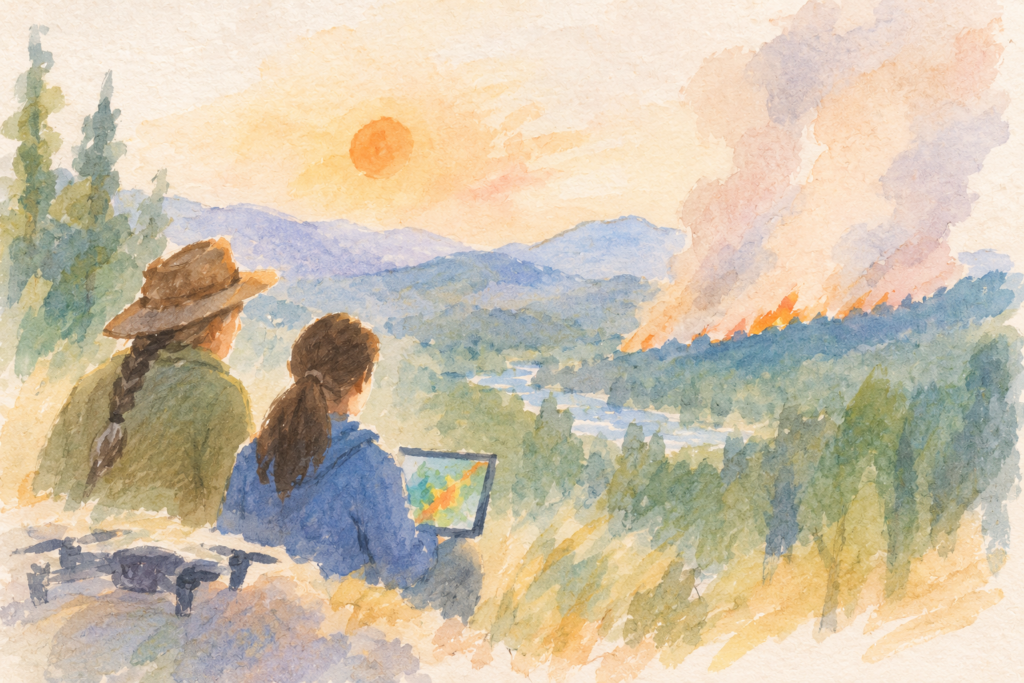
“It is critical that we recognize the importance of traditional ecological knowledge as we steward this land.” — U.S. National Park Service, on a 2017 cultural burn partnership with Great Lakes tribal nations
The smoke from three counties over had turned the sun into a dull orange coin by the time I got home from school, and Nana Ellie was already on the porch, watching it the way some people watch a pot that’s about to boil over.
“Not ours,” she said, before I could ask. “Not yet.”
I set my backpack down and sat next to her. The air tasted like a struck match, the way it had every August for as long as I could remember. Two summers ago, a wildfire had come close enough to take the Delgado’s barn and half the oak stand behind the old mill. I still remember the sound it made from our porch—not loud, exactly, just constant, like something breathing wrong all night.
Nana Ellie has been burning this land, carefully, on purpose, for almost thirty years. She learned it the way she learned everything that mattered: by standing next to someone older than her and doing what they did. In her case, that meant two winters spent working alongside Karuk fire crews near the Klamath River as a young woman, learning to read wind and duff moisture, learning the particular way manzanita brush wants to burn versus how oak leaf litter wants to burn—quick and hot, then slow and low. She always said fire isn’t something you fight. It’s something you keep, the way you keep a garden, or a promise.
For most of her life, keeping that promise had been almost illegal.
“When I was your age,” she told me once, “if I’d lit what my own grandmother used to light, they could have come after me for every dollar it cost to put out a wildfire fifty miles away—whether my fire had anything to do with it or not.” That wasn’t an exaggeration for effect. Under California’s old fire liability rules, a “burn boss” could be held financially responsible for firefighting costs even when a prescribed burn went exactly according to plan, which made insurance for cultural burning practically impossible to get.[1] It wasn’t until 2021 that the state passed a law, SB 332, creating a lower liability standard specifically for what it now formally defines as a “cultural fire practitioner”—someone burning to meet cultural goals passed down through their tribe.[1] Three years later, a second law let tribes skip the standard permitting process altogether by entering direct agreements with the state.[2] Nana Ellie keeps both
documents printed out in a kitchen drawer, like deeds to land she’d always belonged to but had only recently been allowed to stand on in daylight.
“Fifty years of being called the problem,” she said, still watching the orange smear over the ridge. “Turns out we were the answer nobody asked.”
She wasn’t exaggerating that part either. A study out of UC Berkeley found that before fire suppression policy took hold across the Klamath Mountains, the forest there carried roughly half the woody biomass it does today—because tribes were regularly thinning it themselves, on purpose, with fire.[3] In Karuk ancestral territory specifically, researchers estimate there were close to seven thousand intentional, low-intensity burns happening every single year before colonization ended that practice.[4] Seven thousand small, deliberate fires a year, once, doing quietly what a single catastrophic fire now does violently every few summers—except without leveling anyone’s barn.
I’m in the robotics club at school, which Nana Ellie finds both hilarious and, lately, useful. That fall, our club got a secondhand thermal-camera drone through a district STEM grant, and I spent most of October flying it over the ravine behind our property—the one stretch of Nana Ellie’s burn plan she’d been putting off for two years. It was steep, choked with brush, and too dangerous to walk with a drip torch. She’d told the crew it would have to wait until she found more hands willing to risk it.
“I could map the fuel load first,” I told her, turning my laptop so she could see the thermal overlay. “See where the ladder fuel connects to the canopy, where it’s thinnest. You wouldn’t have to send anyone in blind.”
She looked at the drone sitting on the kitchen table like it was a raccoon that had wandered in through the screen door. “Fire doesn’t come from a screen.”
“I know. I’m not saying replace the burn. I’m saying replace the guessing.”
She didn’t answer for a long moment. I understood, even then, that I wasn’t only asking to fly a machine over a hillside. I was asking her to let something new stand beside something she had spent thirty years protecting precisely because no one had let it change.
What convinced her, in the end, wasn’t me. It was my uncle Robbie, who does contract wildland fire work and had just come back from a training where crews were using drones that release small ignition spheres—hollow plastic balls filled with potassium permanganate that catch fire a few seconds after they hit the ground—to light prescribed burns on terrain too steep or too dangerous for a person to walk.[5] The U.S. Forest Service has been using exactly this method to expand how much prescribed burning it can safely complete each year, because it lets crews light hard-to-reach ground without ever putting a body on that ground.[5] At the same training,
Robbie had heard about a federally funded research project called SMART FIRES, where scientists were using ground sensors and drone footage together with machine-learning models to read how a prescribed burn was behaving in real time—tracking wind shifts and fire intensity as they happened, instead of reconstructing them afterward from memory.[6] None of it was speculation. It was a live, grant-funded project, running the same year I was flying a donated drone over my grandmother’s ravine.
“It isn’t about the machine,” Robbie told her over dinner, while she pushed rice around her plate without eating it. “It’s about giving the person holding the torch better eyes.”
Nana Ellie was quiet for a while, long enough that Denny—my twelve-year-old cousin, who thinks everything is either boring or the greatest thing he’s ever seen—stopped chewing to watch her. Finally she said, “Better eyes. Same hands,” testing the words like she was trying on a coat that used to belong to someone else.
We burned the ravine in late November, after the first real rain had come through and the fuel moisture finally sat where it needed to be—a number I pulled that morning from a soil sensor I’d buried two weeks earlier, checked against the humidity and wind data the county fire office posts publicly online. Fire agencies nationwide are leaning harder every year on exactly this kind of layered data—sensors, drones, satellite feeds—to judge fuel moisture and wind before a single match gets struck, according to a 2025 federal report on wildfire technology.[7] That morning, the numbers gave us a four-hour window before the wind was forecast to swing north.
Nana Ellie never touched the drone controls. She never wanted to. She walked the perimeter the way she always had, drip torch low, lighting the ring fire by feel and by memory, murmuring something under her breath in a language I’m still learning—words that weren’t mine to repeat here, only mine to witness. Denny and I worked the flanks with rakes, and Robbie held the north line with the hose. For a while it was almost peaceful: low orange flame combing through dry grass at a walking pace, smoke rising straight and white instead of black and leaning.
Then, forty minutes before the forecast said it would, the wind shifted.
It was small at first—the kind of change that, a generation ago, might have gone unnoticed until it wasn’t. But the sensor reading on my phone caught it before any of us smelled it, a full two minutes ahead. I shouted the number to Robbie. He and Nana Ellie moved the containment line north without a word passing between them, the kind of coordination that comes from thirty years of trusting your own hands, and the fire never got anywhere close to testing the gap. Two minutes doesn’t sound like much. It was the entire difference between a burn day and a headline.
Later, once the flames had settled into a slow black smolder and we were all sitting on the tailgate drinking water that tasted like campfire, Denny asked Nana Ellie if the drone had saved the burn.
“No,” she said, wiping ash from her jaw with the back of her wrist. “We saved the burn. The drone just told us the truth a little sooner than our own noses could.”
By February, green had already come up through the black—not despite the fire, but because of it. Manzanita, whose seeds need heat to crack their hard coating before they’ll sprout at all, was already pushing new leaves through the ash in bright, stubborn clusters. The understory that had
spent two decades choking on its own overgrowth finally had room to breathe. It wasn’t dramatic. It looked, mostly, like an ordinary hillside quietly getting better, which might be the most honest kind of future there is.
I think that’s the part people miss when they picture “the future.” They picture something loud—a gleaming machine solving everything at once, all on its own. What I watched instead was much smaller and much slower: an eighty-year-old wrong finally getting corrected on paper, a drone taking on the parts a human body shouldn’t have to risk, and a woman who has never once needed a screen to know where fire wants to go, deciding that didn’t mean she couldn’t use one anyway.
Good fire isn’t new. It might be one of the oldest ideas people ever had—that you can care for something by understanding it well enough to work with it instead of against it. What’s new is that some of us finally get to help carry it forward, using whatever tools we’ve got, standing next to whoever taught us, doing what they did, a little differently, so it can keep going a little longer than it would have without us.
Next spring, we’re doing the north slope. I’m already charting it.
Works Cited
“Cultural Burn Agreements: Senate Bill 310 Frequently Asked Questions.” California Natural Resources Agency, 24 Feb. 2025, resources.ca.gov/-/media/CNRA-Website/Files/Initiatives/Tribal-Affairs/Cultural-Burn-AgreementsSB-310FAQFinal-2025224.pdf.
“How Drones and AI Are Changing the Way We Fight Wildfires.” Grist, 15 Apr. 2026, grist.org/wildfires/how-drones-and-ai-are-changing-the-way-we-fight-wildfires.
“How Indigenous Practices Can Help Protect Forests.” The Washington Post, 14 Oct. 2025, washingtonpost.com/climate-solutions/interactive/2025/tribes-cultural-burning-california-wildfires.
“How the Indigenous Practice of ‘Good Fire’ Can Help Our Forests Thrive.” University of California, 31 May 2024, universityofcalifornia.edu/news/how-indigenous-practice-good-fire-can-help-our-forests-thrive.
“Igniting the Future: Technology on Prescribed Fire.” U.S. Forest Service, 22 May 2026, fs.usda.gov/about-agency/features/igniting-future-technology-prescribed-fire.
“SB-332 Civil Liability: Prescribed Burning Operations: Gross Negligence.” California Legislative Information, 6 Oct. 2021, leginfo.legislature.ca.gov/faces/billTextClient.xhtml?bill_id=202120220SB332.
“Wildfire Management: Technologies for Forecasting, Detection, Mitigation, and Response.” U.S. Government Accountability Office, 1 May 2025, gao.gov/products/gao-25-108161.
The views and opinions expressed are those of the authors and do not necessarily reflect nor represent the Earth Chronicles and its editorial board.

Comments are closed.