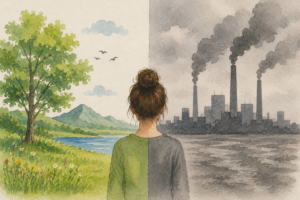
I still remember the day, a few years ago, when residents of my town learned that one of the eight drinking water wells that supplied approximately 25% of the town’s drinking water was contaminated. There were no alarms or headlines, just a notice saying that levels of a chemical called PFAS had tested above Massachusetts’ limits, and that the town was taking action. Even so, it changed how I thought about a basic necessity I had always trusted: water. If this could happen in my town, I couldn’t help but wonder where else it might be happening, without people knowing.
PFAS (per- and polyfluoroalkyl substances) are a group of human-made chemicals used to make products resistant to heat, water, and grease. They are found in everyday items like nonstick pans, food packaging, stain-resistant clothing, waterproof jackets, and firefighting foam. PFAS are often called “forever chemicals” because they do not break down naturally. They accumulate in our environment, contaminating water and soil, and make their way into our food and drinking water. Once they enter the human body, they do not break down, causing them to build up in human tissue over time. The Centers for Disease Control and Prevention has found PFAS in the blood of nearly all Americans. Studies have linked long-term exposure to health problems such as certain cancers, weakened immune systems, hormone disruption, and developmental issues in children. PFAS are not rare pollutants. They are widespread but often go unnoticed.
To my town administration’s credit, they responded with care and urgency. Interim measures were implemented, including distributing bottled water to high-risk residents, conducting public education sessions, and blending water from different wells to keep PFAS levels below state limits. From the start, the Board of Health approached the issue with a clear commitment to protecting public health while evaluating longer-term solutions. Community engagement through thoughtful questions, shared conversations, and participation in public meetings (including my own involvement) helped maintain attention and keep residents informed.
Over time, this collaboration resulted in lasting solutions, including advanced filtration systems and plans to connect to larger regional water supplies. The experience underscored what is possible when public health leadership and an engaged community work together with an informed and grounded approach and with the belief that clean water is a right, not a privilege.
To deepen my understanding, I conducted a research experiment examining how PFAS behaves when present in water or soil used to grow radish and lettuce. The plants appeared completely healthy—lush, green, and undamaged. Yet testing showed that PFAS had entered the edible leaves (50–900 ng/kg). While nanograms per kilogram may seem extremely small, PFAS accumulate over time and do not break down. Currently, the FDA has not established limits for PFAS in food. The European Union, through EFSA, has set a tolerable weekly intake (TWI) of 4.4 ng/kg of body weight. For a 70 kg person consuming 2 kg of food per day, this translates to an approximate limit of 22 ng/kg in food. In comparison, the PFAS levels measured in radish and lettuce were as much as 2 to 40 times the ESFA TWI-based limit. With no smell, color, taste, or visible growth abnormalities, this invisibility is what makes PFAS especially dangerous. Food or water can look safe while still carrying harm.
This outcome piqued my interest in how governments regulate PFAS. Last summer, I studied PFAS regulation across U.S. states and countries. In the United States, rules vary widely, and in many places, remedial action is taken only after harm has already occurred. Other parts of the world, such as the European Union and Japan, take a different approach. They regulate PFAS as a whole group and limit their use, effectively preventing exposure instead of reacting to it later.
This gap is why comprehensive legislation matters. Massachusetts House Bill H.2450, An Act to Protect Massachusetts Public Health from PFAS, reflects a broader understanding of the issue by targeting PFAS across consumer products and everyday exposure pathways, not just drinking water. Complementing this effort, H.109, An Act Protecting Our Soil and Farms from PFAS Contamination, addresses contamination in agricultural land where farmers often lack both the necessary knowledge and protection. Supporting these efforts has often meant working diligently to share research, engaging in dialogue, and helping to translate science into real‑world implications. Together, these bills recognize a critical truth: PFAS exposure moves through water, soil, food, and communities, not in isolation.
PFAS forces us to confront an uncomfortable reality: modern conveniences come at a hidden cost. Stronger regulations are not about fear; they are about foresight. We need policies that ensure not just PFAS-safe water, but PFAS-free cookware, packaging, soil amendments, and consumer goods. Clear labeling, class-based restrictions, and accountability for polluters are essential steps forward. PFAS contamination is not confined to one town or one country. It has surfaced in urban centers and rural communities, near industrial sites and agricultural fields, in surface waters and deep aquifers. The details may differ, but the pattern is consistent: invisible chemicals, delayed regulation, and people left to manage risks they did not create.
The contamination we face today accumulated slowly, quietly over decades. Undoing it will take time, but awareness is the first step. Clean water alone is not enough. Everything we consume should be safe, transparent, and free from chemicals that outlast generations. PFAS may be invisible, but the need to act is clear.
Works Cited
CAS. The PFAS Landscape: Understanding Regulations, Applications, and Trends. American Chemical Society / CAS, 27 Aug. 2025, https://www.cas.org/resources/cas-insights/pfas-landscape
U.S. Agency for Toxic Substances and Disease Registry. Human Exposure to PFAS. Centers for Disease Control and Prevention, https://www.atsdr.cdc.gov/pfas/hcp/clinical-overview/human-exposure.html
European Chemicals Agency. Per- and Polyfluoroalkyl Substances (PFAS). European Chemicals Agency, https://echa.europa.eu/hot-topics/perfluoroalkyl-chemicals-pfas
Massachusetts Legislature. H.109. https://malegislature.gov/Bills/194/H109.
Massachusetts Legislature. H.2450. https://malegislature.gov/Bills/194/H2450.
United States Environmental Protection Agency. PFAS: Our Current Understanding of the Human Health and Environmental Risks of Per- and Polyfluoroalkyl Substances (PFAS). EPA, https://www.epa.gov/pfas/our-current-understanding-human-health-and-environmental-risks-pfas
U.S. Agency for Toxic Substances and Disease Registry. PFAS and Your Health. Centers for Disease Control and Prevention, https://www.atsdr.cdc.gov/pfas/about/index.html
U.S. Geological Survey. PFAS in US Tapwater Interactive Dashboard. https://geonarrative.usgs.gov/pfasustapwater/
The views and opinions expressed are those of the authors and do not necessarily reflect nor represent the Earth Chronicles and its editorial board.