Everything we know of is made of atoms, the smallest indivisible particle of matter. There are, of course, different types of atoms, called elements. These elements join together to form molecules, which in turn form larger and larger components of life— macromolecules, organelles, cells, tissues, organs, organ systems, and, finally, an organism.
Every organism needs to gain these fundamental nutrients in order to perform their necessary bodily functions. Each type has different criteria, for example, photoautotrophs such as plants are defined by the ability to create their own sustenance from light energy: a process called photosynthesis, which also reabsorbs carbon dioxide, a harmful greenhouse gas, from the atmosphere, though not without limitations.
Photosynthesis, as you may have learned from school biology class, is crucial to their growth and survival, but is also significant in the earth’s resistance against climate change because it removes carbon dioxide, an abundant greenhouse gas, from the atmosphere. Glucose is fundamental to plant structure and energy, and contains the elements carbon, hydrogen, and oxygen. However, plants cannot only live using photosynthesis; there are more elements and molecules needed for their survival. Along with other nutrients, plants must gain nitrogen, a significant macronutrient that is a component of chlorophyll, the pigment that captures light in photosynthesis, and nucleic acids such as DNA.
Still, this precious resource is not absorbed easily. Although nitrogen occurs naturally in its diatomic form of N2, where two nitrogen atoms are bonded together, the atoms are held tight by a triple bond that the vast majority of organisms are unable to break. Thus, plants need the help of diazotrophs, bacteria that can “fix” nitrogen. But what does fixing nitrogen mean?
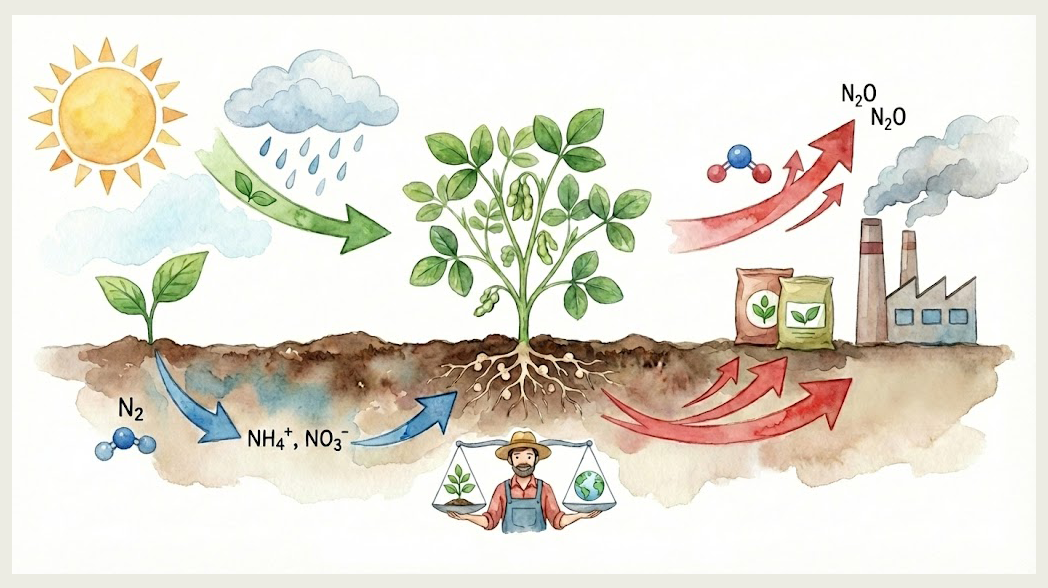
Because plants cannot outright use nitrogen in its diatomic form, they must attain nitrogen from molecules like NO3– or NH4+. There are many chemical pathways that allow for nitrogen to come into the plants’ environment, such as decaying matter, fungi, or nitrogen fixing bacteria in soil. Most often, these nitrogen fixing bacteria break the triple bond in N2 and convert it into ammonia (NH3) or ammonium (NH4+). Then, nitrifying bacteria convert those molecules into NO3– or NO2–.
This complex process involving numerous chemical reactions and the symbiotic relationship between diazotrophic bacteria and plants allows for their survival. Increased plant growth thanks to nitrogen fixation results in more carbon dioxide being removed from the atmosphere due to plants performing photosynthesis. This difference between non-nitrogen-fixers and plants with symbiotic relationships with diazotrophs is particularly evident in land deficient in usable nitrogen. Additionally, when these plants decompose, they leave usable nitrogen to other plants that grow on that soil.
However, there is a downside to nitrogen fixation in terms of climate change. A study performed in 2024 by Sian Kou-Giesbrecht and Duncan Menge estimates that if all trees in an area were to obligatorily perform nitrogen fixation, the soil would release nitrous oxide, or N2O, a greenhouse gas. Because N2O is a significantly more potent greenhouse gas, its impact on pollution and climate change would outweigh the benefits of the CO2 removed from the atmosphere.
However, this effect is not true in all cases since it occurs only when nitrogen is not a limiting factor in plant growth and because nitrogen fixing plants do not release significant amounts of nitrogen into the surrounding soil. Rather, nitrogen can be abundant due to excessive use of fertilizers such as N-P-K (nitrogen, phosphorus, potassium) fertilizers or fossil fuels, thus leading to nitrous oxide emissions. This transfer of nitrogen-containing compounds to the soil is called nitrogen deposition. Furthermore, the degree of nitrogen fixation that contributes or detracts from greenhouse gas emissions depends on the type of biome, such as boreal forest, tropical rainforest, and chaparral. This effect results from the different locations on the Earth that they tend to be found in, for example, tropical rainforests are found near the equator. Similarly, higher latitudes result in dramatic increases in nitrogen fixation, and more so on land than water. Therefore, the plants in this area would contribute more to global warming, albeit slightly.
Other factors besides temperature can increase or decrease nitrogen fixation. For example, depletion of surface nitrate could expand the niche of diazotrophs, resulting in more nitrogen deposition. However, these trends require more research and statistics to find the true extent of the impact of nitrogen fixation on the progression of climate change. Most studies performed on the rates of nitrogen fixation extrapolate their data from previous research due to the difficulties of monitoring large groups of organisms.
Ultimately, more research is needed to expand the study of the degree of effect that nitrogen fixation has on greenhouse gas emissions. However, nitrogen being an essential nutrient for plant growth, drastic reductions to minimize deposition could jeopardize crop yields, food security, and ecosystem stability. Instead, moderation is key: refining agricultural practices to optimize nitrogen use efficiency, supporting biological nitrogen fixation and reducing wasteful overapplication of fertilizers. Such measures would allow plants to thrive while minimizing excess nitrogen that escapes into the atmosphere or waterways. A suitable starting point may be limiting the use of nitrogen-rich fertilizers and fossil fuels where possible by advocating for change in policy. Like all matter is composed of atoms, people—farmers, scientists, lawmakers, and consumers—are the particles responsible for inciting meaningful advancements. Through informed choices, continued research, and collective advocacy, it is possible to reshape the nitrogen cycle in a way that supports both ecological health and human needs, ensuring a more sustainable future in the face of a changing climate.
Sources:
Cabrerizo, Marco J, and Emilio Marañón. “Geographical and Seasonal Thermal Sensitivity of Grazing Pressure by Microzooplankton in Contrasting Marine Ecosystems.” Frontiers in Microbiology, vol. 12, 5 July 2021, pp. 679863–679863, https://doi.org/10.3389/fmicb.2021.679863. Accessed 12 Nov. 2025.
Dentener, F., et al. “Nitrogen and Sulfur Deposition on Regional and Global Scales: A Multimodel Evaluation.” Global Biogeochemical Cycles, vol. 20, no. 4, 28 Oct. 2006, https://doi.org/10.1029/2005gb002672.
Deutsch, Curtis, et al. “Projecting Global Biological N2 Fixation under Climate Warming across Land and Ocean.” Trends in Microbiology, vol. 32, no. 6, 22 Jan. 2024, pp. 546–553, https://doi.org/10.1016/j.tim.2023.12.007. Accessed 11 Nov. 2025.
Kou-Giesbrecht, Sian, and Duncan Menge. “Nitrogen-Fixing Trees Could Exacerbate Climate Change under Elevated Nitrogen Deposition.” Nature Communications, vol. 10, no. 1, 2 Apr. 2019, https://doi.org/10.1038/s41467-019-09424-2.
Kurz, Sophia. “Some Trees May Play an Outsized Role in the Fight on Global Warming | College of Natural Sciences.” Cns.utexas.edu, University of Texas at Austin, 24 Feb. 2022, cns.utexas.edu/news/research/some-trees-may-play-outsized-role-fight-global-warming. Accessed 11 Nov. 2025.
Mosaic. “Nitrogen | Key Nutrients.” Mosaic Crop Nutrition, 2024, www.cropnutrition.com/nutrient-management/nitrogen/. Accessed 11 Nov. 2025.
Whitcomb, Sean. “Biogeochemical Cycles.” Open.maricopa.edu, open.maricopa.edu/environmentalscience/chapter/biogeochemical-cycles/. Accessed 11 Nov. 2025.