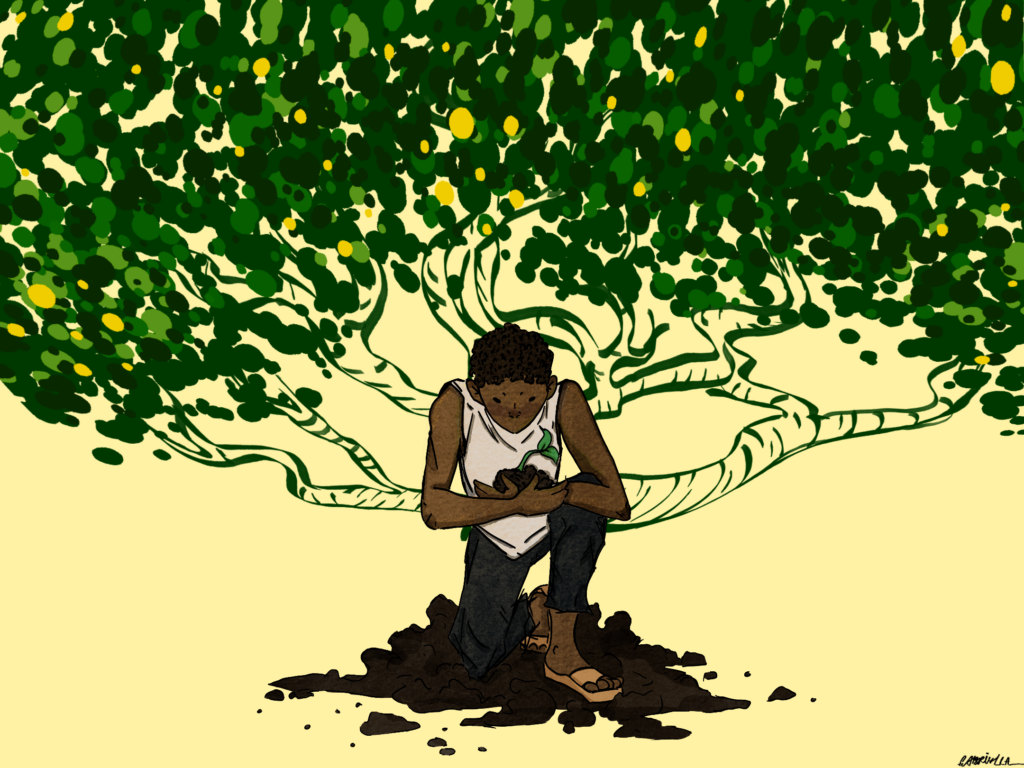
He plunges his fingers into the thick, crumbling soil just as the pale sun rises into the womb of sand-dusted valleys. His father told him, around a cup of sweet tea, that this arid expanse of desert was once a sea, that it rose to the tip of the sky and all the world was blue. But that was millions of years ago. Now, here, he is curling his palms into the shifting earth onto which sunlight has spilled—just enough to make out his hands tilling the dirt. Above him a smattering of birds flash their wings into the early glow.
Shovels are somewhat of a hassle for him to carry out to the stretch of land that will soon be baking in Sahel heat. He’s barely reached nine years of age, and his gangly arms struggle to clasp steadily to anything that isn’t his mother’s warmth, drowned in patterns of silk.
The crescent he etches into the earth is nothing new, in fact thousands of them dot the landscape, birthing sprouts of green as far as the eye can see. But even before hands met the soil again, like they always had, he knew his people had woven back threads of ancient dreams, rediscovering the kinship with breath and plant and dirt already so embedded in their being. As predictable as night and day, men and women would flood into the open valley, sunlight bouncing off dark skin, planting young sorghum seedlings that glistened from the ground, tentatively straining towards the sky.
He is here early because for just a moment this forest that spreads before him is entirely his own. The roots spiraling into the soil will outlast this generation and the next. His whole life, he has been restoring a shell of a world he inherited bled dry. In the rustle of leaves and the palmfuls of dirt he remakes his reality.
The desert has not always been bursting with green, however ancient the farming practice. The village is littered with final breaths that succumbed to the heat as water pools shrank and the rain became a ghost. He knows how once cries split into the air as bodies were drained and how everyone just thirsted. How worlds wilted away when all a mother wanted to do was raise food to her child’s mouth. How this delicate, breathing earth blistered beneath their feet and told them it was dying too.
This lesson has been one of falling back in love with the land, smiles of green sloping across glittering sand, baobab trunks shooting upward as branches spread thin to the clouds. Ithas been of reviving what was trampled out by colonizer’s feet. It has been intertwined with every makeshift shovel and bead of sweat and rainbows of fabric folded over kneeling figures as they breathe life back into the soil.
We are the caretakers of this fragile blue pearl, his father had said. There are cracks that you and I did not place there. But we feel it, in this chapped and charred ground and in the hungry desert winds.
But why try then? Why plant sprouts when the desert is bleeding north and south and we might just choke when the pearl shatters?
His father had looked him in the eyes, pools of dark honey. We know no other world. And maybe the change will not come now, maybe it will take decades. But if we can fill the wounds with flowers that will be enough.
He can’t see it now, like a sun so blinding he has to squint, but there is a vision that lays in this very ground. It is made in the crevices of dark sand spilling with seeds and every daybreak seeping thick and golden through fig leaves. Years from now, the dream will be in the broad foliage that fans out in forests and winding branches. It will be in fruits clinging to the vine and water running clean. And shade sloping from below bushy palm trees where one could write prayers, or songs, or poems. This was a dream into whose patchwork he had been so delicately stitched.
He lifts his head to where the clouds halo around him like he is a bird who has escaped its cage. Leaves cluster over his toes. His fingernails are rimmed with soil. The furrow he’s made is a single grain of sand and he still has a desert left to sow.
And when the earth greets him like an old friend, opening up before him as it welcomes him home, he breaks apart the soil and plants his future. Gentle rays of orange pour over the valley as he works, and more pairs of hands lower life back into the ground.
Maybe ten, twenty years from now, he will stand in this spot and be surrounded by trees, huddled so thick and shining and rustling in light that they blot out the ocean blue sky. He might wander this ground with careful feet and finally see hope blooming there. And maybe he will run his fingers across the surface of each curled leaf, each black branch from which swirls of sparrows scatter, and try to imagine what it feels like to fly.
Author’s Note: This story is a work of fiction inspired by the Great Green Wall of Africa initiative [1], which was started in 2007 by the African Union and aims to fight desertification of the Sahel region by restoring 8,000 km of fertile land. It also works to end hunger, isolate carbon, and create new green jobs. The project is the product of 22 countries’ labor in a region climate change continues to demolish with severe droughts and floods [2]. In 2023 it was reported [3] that the Great Green Wall is 18% completed and remains a symbol of hope that is carried on by dedicated people native to the Sahel as they plant indigenous trees, fight water scarcity, and continue to regreen the only planet we have ever called home.
Works Cited
1. UNCCD (2023) www.unccd.int, Great Green Wall Initiative | UNCCD, 2023. Available from: https://www.unccd.int/our-work/ggwi.
2. Norwegian Institute of International Affairs, Stockholm International Peace Research Institute (2021) Climate, Peace and Security Fact Sheet Sahel.
3. Raman S (2023) Mongabay Environmental News, Progress Is Slow on Africa’s Great Green Wall, but Some Bright Spots Bloom, 2023. Available from:
https://news.mongabay.com/2023/08/progress-is-slow-on-africas-great-green-wall-bu t-some-bright-spots-bloom/.
The views and opinions expressed are those of the authors and do not necessarily reflect nor represent the Earth Chronicles and its editorial board.