They say the jungle remembers. Even when fire has licked its roots and chainsaws have razed its
crown, the jungle’s memory remains bright with the nostalgia of seed and soil. Amara’s
grandmother told her this as they walked the trails of the Raintree Reserve. She’d say that the
land had a soul.
Amara was seventeen when the last tree fell. It had taken forty-eight minutes to sever, even with
the illegal logging rig working full force. She had watched it from the ridge as it burned
helplessly, its limbs crashing like thunder across the ravaged canopy. She could only watch as the
fire consumed six centuries of life. She saw the ghosts of the birds that once nested in its
branches, the howler monkeys that called it home, and her grandmother’s stories about how the
tree connected the sky to the underworld. That tree had stood for over six hundred years before
the day of destruction.
Then came the flood. For three days and nights, the sky wept. The rain poured until the naked
soil slid off the hillsides, and the rivers turned black with runoff. When the water breached the
village, the world that had long ignored their pleas began, finally, to open its eyes.
The president declared a state of emergency and called upon soldiers and photographers in clean
boots who had never once breathed in the musk of wet Earth or heard the jaguars cry at night.
For a brief moment, aid workers made promises they would not keep, and headlines mourned
what they could not pronounce. But when the cameras died down, the villagers were on their
own, left with the impossible question of how to begin again. Amara had no answers. She felt
only rage.
She left school and took a job with a reforestation collective funded by a European NGO. They
led an ambitious plan to replant five million trees across the Andean-Amazonian corridor. They
gave her a tablet, a solar charger, and a heap of agroforestry books, but they couldn’t give her
faith. She’d have to learn that one on her own.
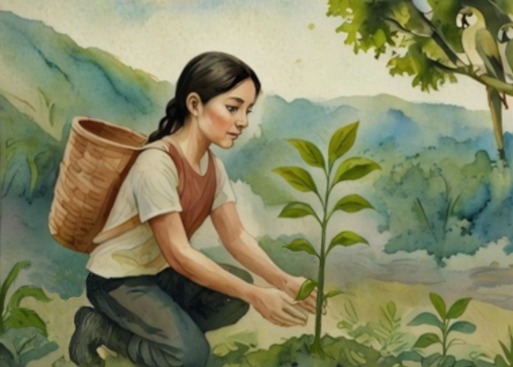
Amara returned to the scarred slopes of her childhood with saplings strapped to her back and
wild cacao, guaba, yacón, and all the other native plants her grandmother had once cultivated in
her pocket.
The men in the village mocked her at first, calling her “la niña del bosque.” Her boots were too
clean, her hands too small. But after the first season, when the seedlings survived, they stopped
laughing. When scarlet tanagers, toucans, and even a harpy eagle returned, everyone started
helping. Restoration, as it turned out, was not about going back, but about moving forward
differently. It was about restoring relationships between humans and the Earth.
A decade passed.
The Raintree corridor had begun to put itself back together. Green spread across the satellite
images, the streams ran clear, and jaguars padded through camera traps. Villagers had new
income from shade-grown coffee and native fruit markets. Kids learned not just Spanish, but
Kichwa names for the plants they grew. No one mocked Amara now.
When the president returned to inaugurate the newly protected Raintree National Reserve, she
offered Amara a seat beside her on the podium. Photographers snapped away as the young
woman in sun-faded boots and soil-stained hands cut the ceremonial ribbon. But Amara’s eyes
were on the treetops, where a pair of macaws were cuddling in the branches of a tree that hadn’t
been there ten years before.
After the ceremony, a reporter asked her, “What changed? Why did it work here, when so many
other efforts have failed?”
Amara paused. She could have mentioned policies or partnerships, grant cycles, or
environmental impact assessments. Instead, she said, “We stopped trying to control the forest and
started listening to it.”
The reporter blinked. “Listening?”
“Yes,” Amara said. “The land has a voice. We just haven’t been listening to it.”
Later that night, back in her village, the elders gathered in the community house to tell stories.
Children passed bowls of cassava soup, and a fire crackled at the center. One of the elders turned
to Amara and said, “Your grandmother would be proud.”
Amara smiled. “I think she knew we’d get here.”
The elder nodded. “She believed that forests don’t die. They sleep, waiting for the ones who
remember how to wake them.”
Outside, the jungle roared in applause.
But the restoration was not over. The planet still suffered. Glaciers receded, coral reefs bleached,
and storms grew fiercer. But here, in this patch of Earth humans once abandoned, Amara rewrote
the story. And like the forest itself, it spread.
First, to the village across the valley, where farmers began fencing off riparian zones and
reintroducing native palms. Then to an urban neighborhood in Quito. Then to Bogotá. Then to
Nairobi. Then to Seoul.
Amara still walked the Raintree trail each morning. She carried only a small knife for grafting, a
basket for gathering seeds, and a notebook filled with the names of every species she had helped
return.
One day, she came upon a little girl crouched beside a sapling. The child was whispering
something to it.
Amara smiled and asked, “What are you saying to the tree?”
The girl looked up shyly. “I’m telling it to grow strong and to remember me.”
Amara smiled knowingly.
The views and opinions expressed are those of the authors and do not necessarily reflect nor represent the Earth Chronicles and its editorial board.