I named her “Calypso.”
Technically, she’s Coral Fragment #882-L of Nursery Row 3B, but that’s a terrible name for someone so extravagant. I can’t show it when the other polyps are around, but she’s my favorite. It could be the way her branches remind me of Mother Nature’s own underwater chandelier, or the way she shimmers when the sun begins to go down, but I genuinely care about her.
And this morning, she grew another three millimeters, again. Third time this week. That’s a sign of active feeding. A good sign.
I logged her growth in my Coral Companion app. It’s kind of like Duolingo, but for marine biology. There’s even a little chime when you successfully log a feeding event. “Another step for reef revival!” it chirps. Cheesy, but I adore that sound all the same.
I still can’t believe I get to do this.
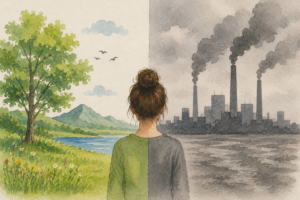
It wasn’t always like this; our coast used to be gray. My mom says the ocean near here was almost silent when she was my age — no parrotfish clicking on coral, no anemones swaying, no technicolor wrasses weaving through branches of reef. Just the occasional fishing boat trailing out and bringing back yet another empty net, and the slow, sloppy, green churn of algae blooms. She says the town struggled then. Fish markets turned into boarded-up memories. Dive shops and beach cafes went bankrupt one by one. Some families left entirely, too many mouths and not enough hope. My grandfather lost his fishing business, and my mother, who never left the water as a child, couldn’t even touch the water without worrying about chemical burns or infections. She remembers walking past the pier where my grandfather used to sell snapper, only to find it lined with warning signs: “Do Not Enter — Algal Bloom Contamination.”
I remember the first time my mom brought me to the coast. I was six. The reef hadn’t yet begun to recover, but we came anyway. She strapped my legs with so much protective gear that I felt like my circulation was going to be cut off. The air reeked of sulfur and rot, infecting my body as if it was going to take root inside me next. I struggled down the trash-covered beach, clinging desperately to her arm as if the water was going to snatch me up and drag me into the greenish gray depths. But I trudged on. We walked up to the shore, where the ocean met the sand, and the sloshing of algae replaced the sound of waves. She knelt beside me on the beach and showed me how to spot the difference between sea foam and algal bloom. The water looked so sick back then, and my six-year-old mouth couldn’t help but dub it “dead water.” My mother just stared at me blankly, holding back the fear she had that I might never have the chance to experience what she once did. Then she said, “It’s like that because we forgot to listen to it.” That moment stuck with me as if it were glued to my brain. Maybe that’s why I listen so closely now.
Then came the Coral Commons Project. Scientists and locals working together to rebuild the reefs, fragment by fragment, inch by inch, piece by piece. Funded by climate organizations and government subsidies, backed by tech and ocean grants, and run by people who actually listen to the very ocean that allowed life to bloom.
And we’re seeing life again.
I joined the Commons when I was thirteen, right after passing my junior field certification with my mother’s encouragement. Our training center used to be an abandoned fish warehouse. Now it’s a vibrant hub with salt-resistant solar panels, 3D printers for reef scaffolds, and a mural that stretches across the seawall: “We are the tide.” My mentor, Dr. Hadi, is a former oceanographer who left academia to work directly with youth-led restoration efforts. She says that we’re the first generation to grow up fixing what others broke. Some days, that feels exciting. Other days it feels heavy. Nonetheless, it’s our burden to bear. The training center doubles as my third favorite place in the world (only upstaged by Calypso’s plot and my bedroom). The warehouse was once the nursery for every coral polyp that now makes up our reef.
The first coral prototypes were designed in laboratories at NOAA and MIT, bioengineered with tougher symbiotic algae, the kind that can survive warmer seas and lower pH levels of our modern age. But they couldn’t just dump them in and call it a day. They needed “fielders” — kids like me — who’d monitor and log changes every morning and night.
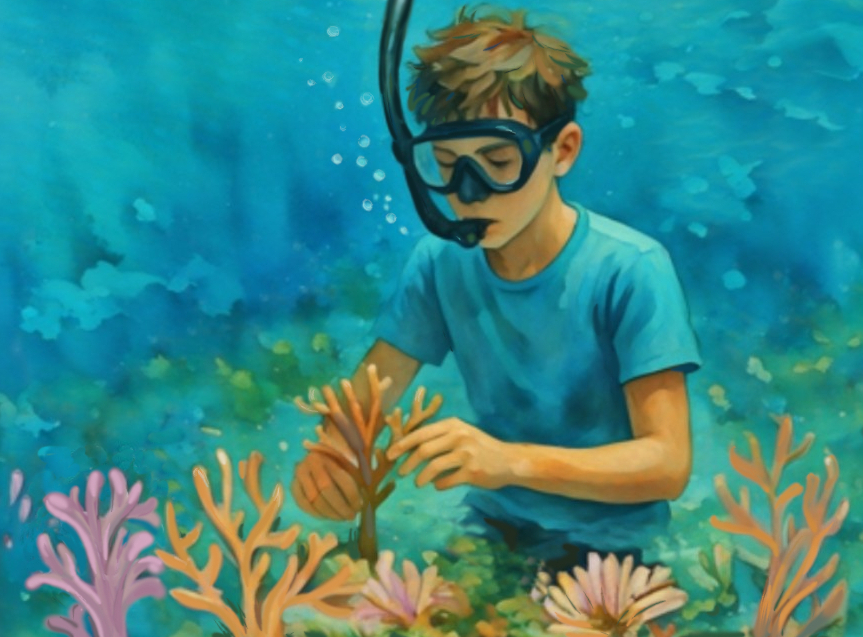
My friends call me a coral babysitter. But I don’t mind, I wear that title with pride. I bike here before school, still rubbing sleep from my eyes, and wearing a sun hat too big for my head. I pass by the darkened homes of my neighbors until I reach my favorite place in the world. The sand beneath my feet is still cold before the sun rises, and the rhythmic sound of crashing waves against the beach is the only thing you can hear besides the occasional bird call. I slip on my reef gloves, lower the sensor drone, and scan for temperature, salinity, and turbidity. Then comes my favorite part, I snorkel down to visit my section.
I strap on my flippers and awkwardly walk backwards into the surf as the waves rush to greet me. It’s chilly, but I don’t mind; you get used to it after a while. I carry my drone with me and take my time as I drift through the water towards Calypso. Some days, I bring music; Calypso likes the cello, I think. Or
maybe it’s just me. Either way, I always hum when I’m with her. I think it gives her something to look forward to, but my mom says that it’s just wishful thinking on my part. The water wraps around me like a second skin. It’s quiet down here, except when I bring my music, of course. I hover above Calypso’s section, careful not to stir sediment. Her polyps open slowly in the current, like tiny mouths, feeding, breathing. I swear I can feel it too, that gentle rhythm, like the reef has a pulse. I can almost feel my heart match the rhythm, the pulsing of the reef lining up with mine.
Our reef stretches about 400 meters now. It’s modular engineered from biodegradable ceramic frames that mimic the structure of reef ridges. Seaweed is growing thick between the pods. The crabs are back. A group of kids from inland just saw a reef squid for the first time last week and screamed so loud I think they scared it to the Pacific.
But the best part? The reef is changing the water.
The new coral polyps are stabilizing the pH, taking carbon from the water, and sequestering it in the form of calcium carbonate. When I look at Calypso, I witness hope etched in every fiber of her being. Tiny, natural architecture that fights the same emissions that once destroyed it.
One tiny coral can’t change the world, but a billion might.
And then comes my least favorite time, as I make the trek back through the water to the beach and am forced to shed my marine armor, which consists of my snorkel and flippers. I dry off and run up the now blistering sand, hop on my bike, and try my best to make it to school on time.
My teachers know I’ll be late; it’s one of the perks that come with being in the Coral Babysitter’s Club —a get-out-of-jail-free card when it comes to being tardy to homeroom. Mr. Mcall stares me down as I trudge into first period in my still dripping wet clothes. I try my best to sneak around his gaze as he continues his lectures on climatology. It was my favorite class this semester, and unfortunately, the one I missed the
most. But, to be fair, I had heard it all before the first time I sat through the Coral Commons orientation. The unfortunate choices of past generations have all culminated in a climate crisis that my generation will have to fix. And there’s a lot to fix. Carbon sequestration is at an all-time low, despite improvements over the past seven years. Forests. Forests are struggling to rebound even after replanting efforts began, and the ocean remains far too acidic. But Calypso is helping with that last part. I anxiously sit through my last day of school for the year, waiting and watching the clock as it moves closer to my second favorite time of the day, my afternoon check-in.
The dismissal bell chimes, and I hug my friends goodbye and race off to my bike. I can’t put my helmet on fast enough before I’m pedaling full speed towards the beach. I pass through the now fully alive town, bustling with locals and tourists alike as they gawk at the window displays and murals of ocean creatures that line the streets. I stop at the training center to leave my bike and make my way down to the beach. I slip on my flippers like a selkie slipping on its seal skin, walking backwards into the tides with a bit more grace than in the morning.
I glide along the coral pathways to Calypso, but something’s off. My scanner showed low turbidity readings, and the water smelled different, like metal, salt, and something else. I lowered the drone and scanned the surrounding plots. My screen flashes red, big bold letters emerge with the phrases “LOW OXYGEN, REPORT IMMEDIATELY.” I begin to panic. My fingers struggle to respond as I fiddle with my tablet, signaling a level 3 disturbance to Dr. Hadi. I pump my legs, pushing myself to the surface as I remove my snorkel. The water around me is coated with a film, chemically bile liquid that seems to suffocate everything around it. I strap back on my snorkel and continue to follow the coral path. I have to check on Calypso; she was doing so well, growing so well. Then the questions fill my mind. What if she can’t come back from this? What if this was the last time I got to see her at her best? What if the “dead ocean” that plagued my nightmares as a child returns? And when I reach Calypso, my heart sinks. It looks as though the life was sucked out of her. The polyps that blanketed her fans are closed; the white tips on them, which signified growth, are no longer there. Calypso’s branches were paler than I remembered. Not white, not bleached, yet, but duller, like she was holding her breath.
My head hurts as I struggle to make my way back to the warehouse. As I pull myself from the water, Dr. Hadi waits on the observation deck. The entire beach is on red alert. Volunteers follow drones and sensors across the bay, rushing samples back to the lab for testing one by one. I push myself to join them. Finally, after what seemed like hours, the results returned. Some of the new pods had been leaching chemicals. A batch error. Manufacturing flaw. The Commons paused all transplant activity for the week.
After my afternoon check-in, I sit on the observation deck and sketch Calypso again. I always draw her bigger than she is. She’s already full-grown in my sketchbook, branching like a hand stretching toward the surface, pulsing with genetically altered zooxanthellae life. A refuge for fish, a maze for sea slugs, the centerpiece of the reef. This might be the only chance I’ll have to see her like this. One small human error, and suddenly, life changes so rapidly for an entire ecosystem. Dr. Hadi approaches me. She sits beside me and sighs, placing a hand on my shoulder.
“Calypso will be fine, you, on the other hand, need to get some rest.” She says it’s what she thinks is comforting, but really, that just ignited my worrying even more.
As the activity at the beach dies down and everyone leaves for the night, I remain. I sat on the rocks that night, watching the water turn lavender in the sunset, wondering if I’d failed her, if we failed them all.
But Calypso held on. I spent the next week of paused activity in the water. I brought extra nutrient solution, manually fanned the water, and played cello recordings even when I felt silly. Three days passed, and she didn’t show any improvement, but I persisted. On the fourth day, her color deepened. A soft shade of orange returned to her, and I almost teared up. On the fifth day, her polyps reopened. And this morning, she grew another three millimeters. I swim beside her, hoping and praying that my drawings will come to life, that the coral before me will one day be the centerpiece of our town’s reef.
It’s weird. Most of my friends dream of leaving, of going inland to cities or Mars colonies. But I dream of the ocean.
I want to study marine biology in college, help design the next generation of coral that won’t just survive, but sing back the ocean’s rhythms. I hope someday Calypso’s great-great-grandchildren will be monitored by my own descendants, or spread around the other bleaching zones of Florida. Maybe coral can teach us how to come back from the edge. What my mother and grandparents had to experience is the past, and I
must be the one to tend to the future.
Someday, maybe a kid like me will find a coral like her and give it a name. Not a number, not a label, just a name. And they’ll love it just as much as I did. And the reef will keep growing, inch by inch, heartbeat by heartbeat.
The ocean doesn’t ask for perfection. It asks for patience. For presence. For persistence. Maybe that’s all hope is, showing up again and again for what might still bloom. And if we can do that — if we can listen better this time — then maybe the ocean won’t just forget us. Perhaps it will forgive us, too.
There’s a poem I read once that said:
“Hope is a thing with feathers.”
But here, in this town, in this moment, in this ocean, hope is a thing with polyps. And today, it grew another three millimeters.
The views and opinions expressed are those of the authors and do not necessarily reflect nor represent the Earth Chronicles and its editorial board.