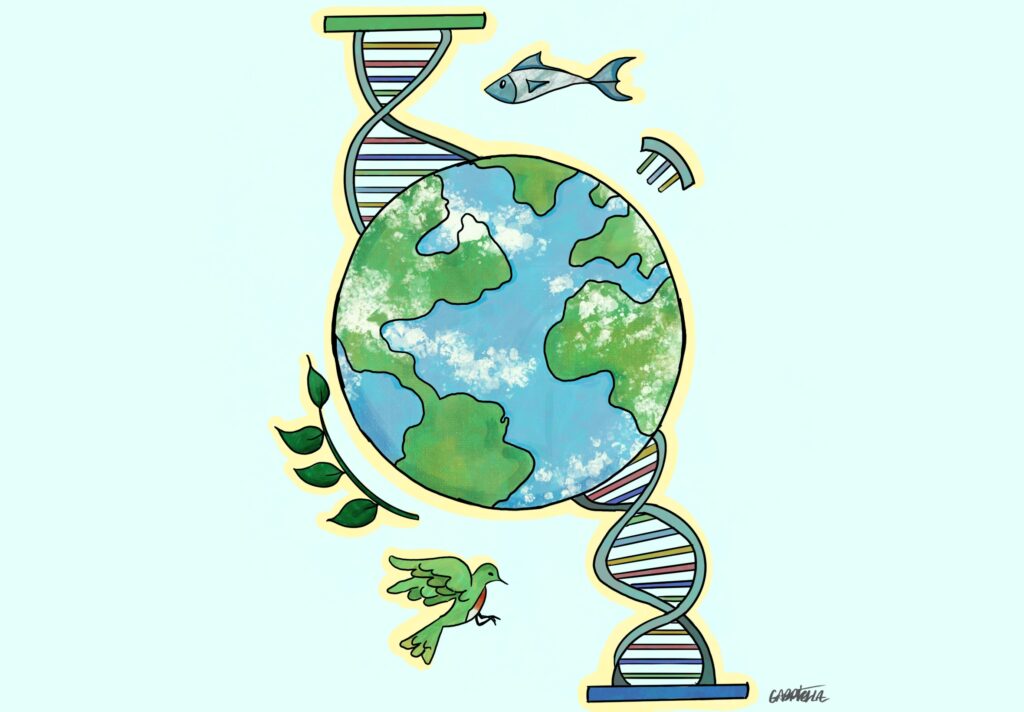
As we shift into an age marred by climate struggles and warming temperatures, the responsibility to protect our environment and the future of our world falls to humanity. Climate change has resulted in consequences affecting society’s most vital components, from farming, water security, and access to clean air. As a result, scientists have been investigating methods to allow humanity and the Earth to adapt to a new, hotter climate.
Genetic engineering has grown into one of the hottest topics for scientists interested in climate change adaptation. In simple terms, genetic engineering is editing or modifying the instructions that make up a living organism. Every living thing has a “master blueprint” called DNA. DNA dictates how tall an organism is, how it fights off disease, and even its color. In the process of genetic engineering, scientists make changes in these biological instructions. This could take the form of removing a particular set of instructions (a gene) using methods like CRISPR, or inserting a new strand of DNA to give an organism new traits.
In the case of climate change adaptation, scientists can use genetic engineering for a wide array of applications. As CO2 levels continue to rise, carbon sequestration cannot keep up. To remedy this, scientists use methods like CRISPR to engineer trees and other crops to increase the efficiency of photosynthesis, allowing for increased rates of carbon sequestration. In addition, scientists have been investigating the role of certain genes in the ability of plants to survive in high-temperature climates, with the goal of producing crop species more resistant to the effects of global warming.
Beyond heat resistance, genetic engineering could also alleviate issues surrounding the increased prevalence of drought and changing rainfall patterns. As temperatures rise, agricultural practices have been limited by increased water stress, posing a direct threat to global food stability, especially in at-risk areas. Through the modification of genes responsible for water retention, root development, stress response, and growth patterns, scientists may be able to create crop strains that use less water while maintaining or even increasing current production rates. Similar approaches could lead to improved efficiency of surviving in non-nutrient, high-salt-content soils, an adaptation growing increasingly more important as pesticides and fertilizers see increased use. In regions impacted by rising sea levels and high salt content soils, this adaptation could be vital for crop growth within the region. Even in areas where nutrients are scarce, a focus on finding such genes could allow for crops to grow in deserts or mountainous regions.
Despite genetic engineering’s potential benefits, limitations and drawbacks are prevalent. Modification of DNA does not guarantee desirable traits will be developed in the organism without unintended consequences. Interactions between genes are complex, and changing one gene can create downstream effects that impact other biological processes. Additionally, introducing genetically modified species into environments can create ecosystem disasters, as their impacts need to be monitored to analyze their destructive potential. For instance, genetically modified organisms could outcompete their non-modified counterparts, leading to an ecological crisis. Further, genetically modified organisms could spread their genetic traits to native species, with environmental impacts being unpredictable. Besides ecological threats, the use of genetic engineering is heavily disputed for economic and ethical considerations, particularly about who controls the use of such techniques and experiments.
Genetic Engineering represents a promising tool in humanity’s efforts to adapt to climate change. From improving carbon sequestration to developing crops that are able to survive in a changing world, the technological uses of genetic engineering could allow humanity to thrive in a climate-change-stricken world. But it is important to realize that genetic engineering does not solve the issue of climate change, and is merely a band-aid to its effects. Genetic engineering is just one component of a much larger, effective response to climate change. As research continues to advance and the ability to modify the instructions behind life increases, it may become increasingly intertwined with humanity’s survival in a world marred by climate change.
Works Cited
Dixon, G. B., et al. “Genomic Determinants of Coral Heat Tolerance across Latitudes.” Science, vol. 348, no. 6242, 2015, pp. 1460–1462. https://www.science.org/doi/10.1126/science.1261224?referrer=https%3A%2F%2Fwww.google.com%2F
Groover, E. D., et al. “Genome Engineering of Plant Photosynthesis for Carbon Sequestration.” Nature Reviews Bioengineering, 2026. https://www.nature.com/articles/s44222-026-00453-3
Humanes, A., et al. “Selective Breeding Enhances Coral Heat Tolerance to Marine Heatwaves.” Nature Communications, vol. 15, 2024, article 8703. https://www.nature.com/articles/s41467-024-52895-1
Prado, K., et al. “Building Climate-Resilient Crops: Genetic, Environmental, and Technological Strategies for Heat and Drought Stress Tolerance.” Journal of Experimental Botany, vol. 76, no. 16, 2025, pp. 4395–4413. https://academic.oup.com/jxb/article/76/16/4395/8068105
Shelake, R. M., et al. “Engineering Drought and Salinity Tolerance Traits in Crops through CRISPR-Mediated Genome Editing: Targets, Tools, Challenges, and Perspectives.” Plant Communications, vol. 3, no. 6, 2022, article 100417. https://www.cell.com/plant-communications/fulltext/S2590-3462(22)00249-8?_returnURL=https%3A%2F%2Flinkinghub.elsevier.com%2Fretrieve%2Fpii%2FS2590346222002498%3Fshowall%3Dtrue
Zaidi, S. S.-A., et al. “Engineering Crops of the Future: CRISPR Approaches to Develop Climate-Resilient and Disease-Resistant Plants.” Genome Biology, vol. 21, 2020, article 289. https://link.springer.com/article/10.1186/s13059-020-02204-y
The views and opinions expressed are those of the authors and do not necessarily reflect nor represent the Earth Chronicles and its editorial board.





Comments are closed.