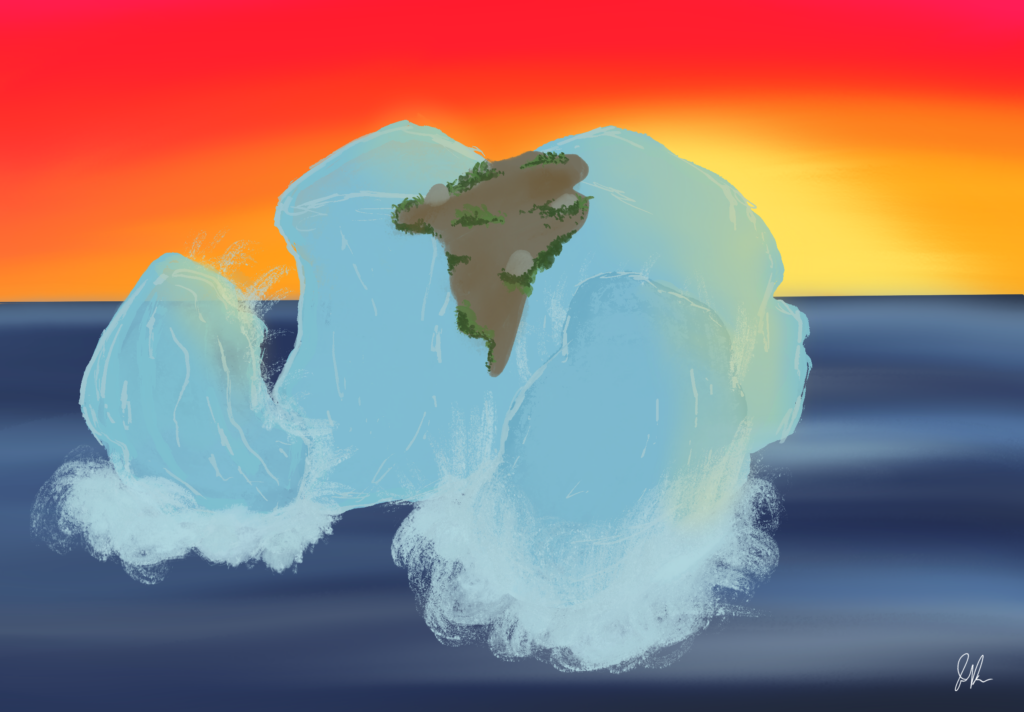
A glacier does not vanish into nothing.
It turns into geography.
Where there was once a wall of ice, there may be a lake. Where ice once crushed stone beneath its weight, insects may eventually crawl through moss. Rivers can change course. Plants arrive. Animals follow. A coastline can receive a different mixture of freshwater and sediment. Even the groundwater beneath people’s feet can shift.
We usually tell the story of melting glaciers as a story of subtraction: less ice, less snow, less frozen Earth.
That is true, but incomplete.
The disappearance of a glacier also begins something. It exposes land that may not have seen sunlight for centuries or millennia and leaves behind one of the planet’s strangest ecological experiments: a landscape starting over.
In the 2025 hydrological year alone, glaciers outside the Greenland and Antarctic ice sheets lost an estimated 408 billion metric tons of ice. Since 1975, their total mass loss has reached about 9.6 trillion metric tons, enough to contribute roughly 26 millimeters to global sea-level rise (Zemp et al.).
Those numbers are enormous, but numbers can make disappearance feel strangely abstract. Instead, imagine standing at the edge of a retreating glacier and taking one step forward.
The ground beneath your boot may have been under ice for centuries, even millennia. What happens next?
Newly exposed ground is not a garden waiting politely for the ice to leave.
It can be cold, unstable, and poor in nutrients, with little recognizable soil. Fine sediment and broken rock dominate. Water follows unfamiliar channels. Temperatures can swing sharply.
And yet life begins arriving.
A 2024 study examined 46 landscapes exposed by retreating glaciers around the world. Researchers found that the richness of bacteria, fungi, plants, and animals generally increased
with time since the ice disappeared. Microorganisms were among the fastest colonizers, particularly during the first decades, while most larger organisms took longer (Ficetola et al.).
The first inhabitants of a world emerging from ice may therefore be organisms too small to see.
Microbes begin altering the chemistry of the new environment. Organic material accumulates. Plants establish themselves. Their roots and dead tissues further change the developing soil, while the plants themselves create habitat and connections for other organisms.
What initially looks almost sterile begins acquiring relationships. A new ecosystem starts assembling.
Sometimes animals help speed that process along.
At the foot of Peru’s Uruashraju Glacier, researchers established experimental plots on terrain that had emerged from beneath the ice roughly 24 to 40 years earlier. Some plots included llamas; others did not. After three years, soils in the llama plots showed significant increases in organic carbon and nitrogen. Between the second and third years of the experiment, vascular plant cover in those plots increased by 57 percent (Zimmer et al.).
The reason is wonderfully practical. Llamas create nutrient-rich dung piles and carry seeds into newly exposed terrain.
The majestic question How does life colonize ground released from ancient ice? has, among its answers, llama dung.
There is a temptation to turn this into a comforting story.
If glaciers disappear and new ecosystems emerge, perhaps nature simply adjusts. Ice vanishes, plants arrive, biodiversity grows, and one habitat replaces another.
But ecological change is not an exchange in which the new habitat cancels the loss of the old one.
Glaciers shape specialized environments of their own. Cold meltwater influences river temperature, sediment, nutrients, and flow. Organisms adapted to glacier-fed systems can lose suitable habitat even while other species colonize newly exposed ground.
A 2023 study modeled the future distributions of 15 cold-water invertebrate species across the European Alps. Where glaciers persist, many of those species are projected to shift farther upstream. Where glaciers disappear completely, some populations are projected to become functionally extinct (Wilkes et al.).
The ecological story is therefore not simply:
ice → barren ground → flourishing nature
It is a simultaneous process of loss and creation. One ecosystem contracts while another begins assembling in its footprint.
The scale could be enormous. Researchers estimate that glacier retreat outside Greenland and Antarctica may expose roughly 149,000 to 339,000 square kilometers of new terrestrial, freshwater, and marine ecosystems by 2100, depending on future climate conditions (Bosson et al.).
At the upper end, that is an area roughly comparable to Finland.
Entirely new places for species to inhabit are appearing.
Glaciers are sometimes described as natural water towers. They store water as ice and release meltwater downstream.
A shrinking glacier, however, creates a peculiar illusion before its loss becomes obvious. For a while, the river may receive more glacier water.
As temperatures rise and melting accelerates, additional water is released from long-term ice storage. Eventually the glacier becomes too small to continue supplying that extra runoff.
Scientists call the turning point peak water.
After peak water, the glacier’s contribution to downstream flow declines (Intergovernmental Panel on Climate Change).
Imagine slowly emptying a savings account while watching your monthly spending money increase. For a while, you feel richer.
Then you look at the balance.
The Intergovernmental Panel on Climate Change reports that peak glacier runoff can exceed the initial annual runoff by 50 percent or more in some settings. Afterward, that additional supply diminishes as the glacier continues to shrink.
The consequences can reach agriculture, drinking-water systems, hydropower, and freshwater ecosystems. Glacier retreat can also alter when water arrives during the year, not only how much eventually arrives.
And rivers are more than pipes carrying melted ice downhill.
They carry sediment. They carve channels. They exchange water with underground aquifers. Change a glacier, and the architecture of the watershed can change with it.
Near Alaska’s Mendenhall Glacier, retreat helped create Mendenhall Lake, which reduced the supply of coarse sediment moving into the Mendenhall River. Surveys found that portions of the riverbed lowered by as much as 1.5 meters between 1969 and 1998. A nearby observation well also recorded a decline in the water table over subsequent years (Neal).
The ice moved backward, the river cut downward, and groundwater responded. A glacier can retreat kilometers away and still rearrange what happens beneath someone’s feet. Follow glacier water far enough and the story reaches the sea.
Along the Gulf of Alaska, glaciers influence enormous quantities of freshwater entering coastal waters. The U.S. Geological Survey reports that annual freshwater discharge associated with glacier melt into the Gulf of Alaska is comparable in scale to the discharge of the Mississippi River. Research estimates that glaciers and icefields account for nearly half of the region’s total freshwater discharge (Alaska Science Center).
That freshwater helps drive the Alaska Coastal Current and influences highly productive marine habitats used by fish, seabirds, and marine mammals (Alaska Science Center).
The disappearance of mountain ice, then, is not necessarily a mountain problem.
A glacier affects a river. The river reaches an estuary. The estuary feeds into coastal circulation and marine food webs.
Pull on the ice and the thread keeps going.
Ground emerging from beneath a glacier contains another unusual feature: time.
Walk away from the modern edge of a retreating glacier and, in some landscapes, you can pass through different ages of ecosystem development.
Close to the ice may be recently exposed stone and sediment. Farther away, where retreat occurred decades earlier, microorganisms and pioneering plants may have established themselves. Still farther away, older soils and increasingly complicated biological communities can appear.
Ecologists call these sequences chronosequences. By comparing surfaces uncovered at different times, researchers can study how ecosystems assemble over years and decades (Ficetola et al.).
The glacier leaves dates written across the landscape.
Today, however, those dates are appearing quickly. A 2026 global assessment found that six of the highest glacier mass-loss years in the observational record occurred within the previous seven years (Zemp et al.).
Someone can photograph a glacier as a child and return decades later to find a lake. A stream can extend into land that was previously buried.
An animal can cross habitat that did not exist when its grandparents were born. This may be one of the strangest conservation questions created by glacier retreat. When a glacier pulls back and exposes a valley, what exactly should conservation protect? The ice that remains?
The cold-water species retreating toward it?
The new ecosystem forming behind it?
The river extending into newly uncovered terrain?
Perhaps all of them.
Traditional conservation often begins with a place that already exists: identify a valuable habitat, draw boundaries around it, and try to preserve its ecological character.
Glacier landscapes complicate that model because the boundaries themselves are moving.
Researchers studying future post-glacial ecosystems found that less than half of present glacier areas lie within protected areas (Bosson et al.). Another study found that existing protected-area networks in the European Alps provide relatively poor coverage of some places projected to become future refuges for cold-water invertebrates (Wilkes et al.).
That creates an unusual mismatch.
The habitats species may need tomorrow are not necessarily the habitats protected today.
A retreating glacier can uncover new land while simultaneously forcing cold-adapted organisms farther uphill. A protected area designed around the present ice margin may eventually contain neither the same amount of ice nor the same ecological community.
Conservation in these places may therefore have to protect more than fixed patches of terrain. It may have to protect transitions.
That could mean maintaining connected river networks so organisms can move upstream, anticipating where future cold-water refuges may occur, safeguarding newly exposed terrain before it is heavily altered, and protecting the remaining glaciers themselves by addressing the warming that is driving their retreat.
This is a less comfortable version of conservation.
“Keep this place the way it is” is simple.
“Give this place room to become something else without losing everything it was” is harder. But glacier landscapes are increasingly forcing us to confront the second problem. Someday, on ground that is still beneath a glacier today, something will grow.
Perhaps bacteria will arrive first, followed by mosses and other pioneering organisms. A seed may travel on an animal’s fur or pass through its digestive system. Eventually, roots may work through sediment that for centuries or millennia knew only darkness, pressure, and ice.
There is wonder in that.
But wonder should not be mistaken for consolation.
The first flower on newly exposed ground does not make the vanished glacier unimportant. It is evidence that the planet is responding to profound change.
A disappearing glacier becomes more than water. It becomes altered rivers, new lakes, exposed stone, changing groundwater, and habitat that did not exist before.
Its absence becomes an environment of its own.
We are not only witnessing landscapes disappear.
We are watching landscapes begin.
Works Cited
Alaska Science Center. “Tidewater Glacier Influence on Marine Ecosystems.” U.S. Geological Survey, 14 Mar. 2025,
www.usgs.gov/centers/alaska-science-center/science/tidewater-glacier-influence-marine-ecosyste ms. Accessed 21 Aug. 2026.
Bosson, J. B., et al. “Future Emergence of New Ecosystems Caused by Glacial Retreat.” Nature, vol. 620, 2023, pp. 562–69. https://doi.org/10.1038/s41586-023-06302-2.
Ficetola, Gentile Francesco, et al. “The Development of Terrestrial Ecosystems Emerging After Glacier Retreat.” Nature, vol. 632, 2024, pp. 336–42.
Intergovernmental Panel on Climate Change. “FAQ 2.1: How Does Glacier Shrinkage Affect River Runoff Further Downhill?” Special Report on the Ocean and Cryosphere in a Changing Climate, 2019, www.ipcc.ch/srocc/about/faq/final-faq-chapter-2/. Accessed 21 Aug. 2026.
Neal, Edward G. “Channel Incision and Water-Table Decline Along a Recently Formed Proglacial Stream, Mendenhall Valley, Southeastern Alaska.” Studies by the U.S. Geological Survey in Alaska, 2007, edited by Peter J. Haeussler and John P. Galloway, U.S. Geological Survey, 2009, Professional Paper 1760-E. https://doi.org/10.3133/pp1760E.
Wilkes, M. A., et al. “Glacier Retreat Reorganizes River Habitats Leaving Refugia for Alpine Invertebrate Biodiversity Poorly Protected.” Nature Ecology & Evolution, vol. 7, 2023, pp. 841–51. https://doi.org/10.1038/s41559-023-02061-5.
Zemp, Michael, et al. “Global Glacier Mass Change in 2025.” Nature Reviews Earth & Environment, vol. 7, 2026, pp. 213–15. https://doi.org/10.1038/s43017-026-00777-z.
Zimmer, Anaïs, et al. “Llamas (Llama glama) Enhance Proglacial Ecosystem Development in Cordillera Blanca, Peru.” Scientific Reports, vol. 13, 2023, article 15936. https://doi.org/10.1038/s41598-023-41458-x.


Comments are closed.