Illustrated by Julianne Park. All rights reserved.
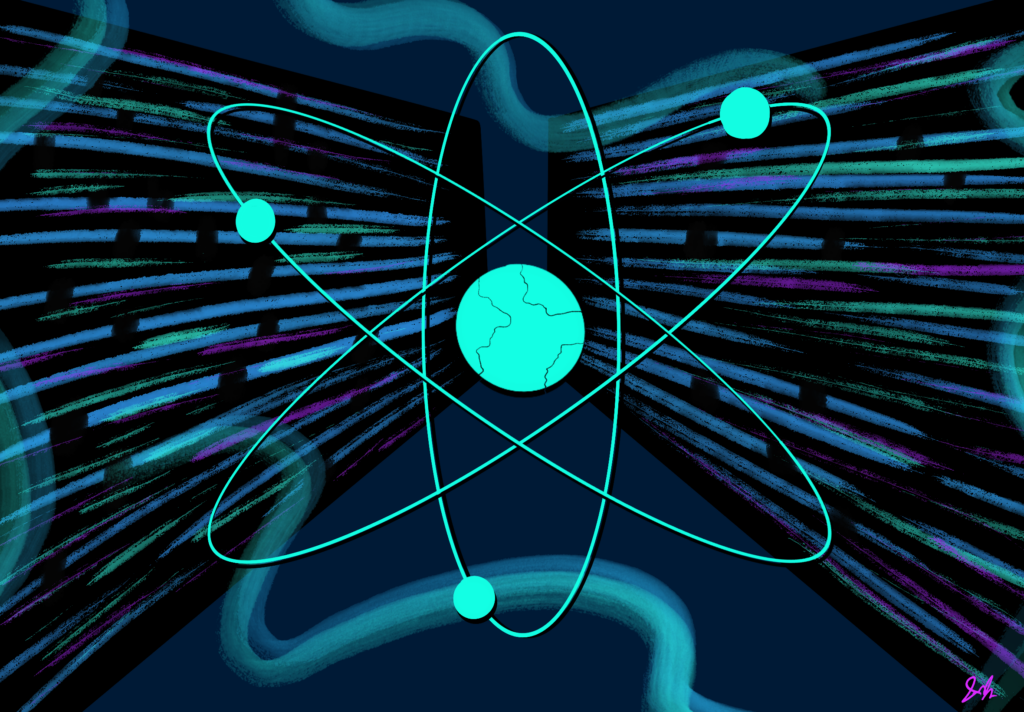
The last time America approved a new nuclear reactor for construction, ChatGPT didn’t exist, most people had never heard the word “data center,” and the United States was nowhere near the energy crisis of today, which was quietly brewing beneath the surface. That was 2018, and the plant was never even built. Now, on March 4th, 2026, the federal government finally approved another: Bill Gates’s TerraPower reactor in Kemmerer, Wyoming. A lot has changed, yet our energy infrastructure hasn’t kept up.
Every time you use ChatGPT, stream a video, or scroll through your feed, a massive data center somewhere is drawing enormous amounts of power. A single AI-powered search query consumes nearly ten times more electricity than a standard Google search. Tech giants like Meta, Microsoft, and Google need power that is constant, reliable, and clean, yet the American grid is already straining to keep up. The solution has to come from somewhere. And increasingly, that somewhere could be nuclear energy.
Nuclear energy produces massive amounts of electricity, emits no greenhouse gases, and runs around the clock without interruption. Other clean options like wind and solar struggle due to their variable nature, making it difficult for them to integrate with our current power grid and deliver the reliability that skyrocketing electricity demand now requires. For decades, nuclear energy has been heavily scrutinized. Disasters like Chernobyl in 1986 and Fukushima in 2011 burned themselves into public memory, and strict regulations made building new plants feel nearly impossible. However, even many longtime opponents have come around, realizing that the math on climate change simply can’t work without nuclear energy in the mix.
So why has it taken so long? The short answer: nuclear power is hard, expensive, and politically fraught. The Vogtle plant in Georgia, the last reactors built from scratch in the U.S., cost $35 billion, double initial estimates, and came online seven years late. Public fear didn’t help either, and regulatory agencies like the Nuclear Regulatory Commission faced intense pressure to scrutinize every application. Critics accused the NRC of being so cautious it became an obstacle, taking years to review applications other countries processed in months.
The result was a decade-long standstill. While energy demand climbed, and climate deadlines loomed, America essentially stopped building nuclear power. Until now.
On March 4th, 2026, the Nuclear Regulatory Commission unanimously voted to grant a construction permit to TerraPower, a nuclear startup founded by Bill Gates. It is the first new commercial reactor to receive federal approval in nearly a decade. The plant will be built in Kemmerer, Wyoming, a former coal community, offering a glimpse of what a real transition away from fossil fuels could look like for working towns across America. TerraPower’s design uses liquid sodium instead of water and a molten salt battery, making it safer, smaller, and more flexible than traditional reactors. Meta has signed on for up to eight TerraPower reactors to power its data centers, showing the demand for this power already exists.
There are still hurdles: costs, supply chains, and an operating license from the NRC. There’s no guarantee this plant avoids the fate of Vogtle. But for a country that stood still on nuclear for a decade while energy demand reached a breaking point, this approval matters. The AI revolution didn’t wait for the grid to catch up. Climate change didn’t pause while policymakers debated.
March 4th, 2026 isn’t a magical turning point. But it might just be the moment nuclear gets a second chance that America can’t afford to miss.
Works Cited
Editors of MIT Technology Review. “We Did the Math on AI’s Energy Footprint.” MIT Technology Review, 20 May 2025, www.technologyreview.com/2025/05/20/1116327/ai-energy-usage-climate-footprint-big-tech.
Goldman Sachs. “AI Is Poised to Drive 160% Increase in Data Center Power Demand.” Goldman Sachs Insights, 2024, www.goldmansachs.com/insights/articles/AI-poised-to-drive-160-increase-in-power-demand.
Kanoppi. “Search Engines vs AI: Energy Consumption Compared.” Kanoppi, 17 Aug. 2025, kanoppi.co/search-engines-vs-ai-energy-consumption-compared.
Plumer, Brad. “A Nuclear Reactor Backed by Bill Gates Gets Federal Approval to Start Building.” The New York Times, 4 Mar. 2026, TTTwww.nytimes.com/2026/03/04/climate/terrapower-nuclear-reactor-permit.html. World Nuclear Association. “Nuclear Power in the USA – World Nuclear Association.” World-Nuclear.org, 5 Mar. 2024, world-nuclear.org/information-library/country-profiles/countries-t-z/usa-nuclear-power.
The views and opinions expressed are those of the authors and do not necessarily reflect nor represent the Earth Chronicles and its editorial board.