California’s unpredictable weather cycle peaks this winter as rain relentlessly pours down on the drought-ridden state. This excess rain and snowfall across the western coast of the U.S. is a result of a natural phenomenon called the atmospheric river.
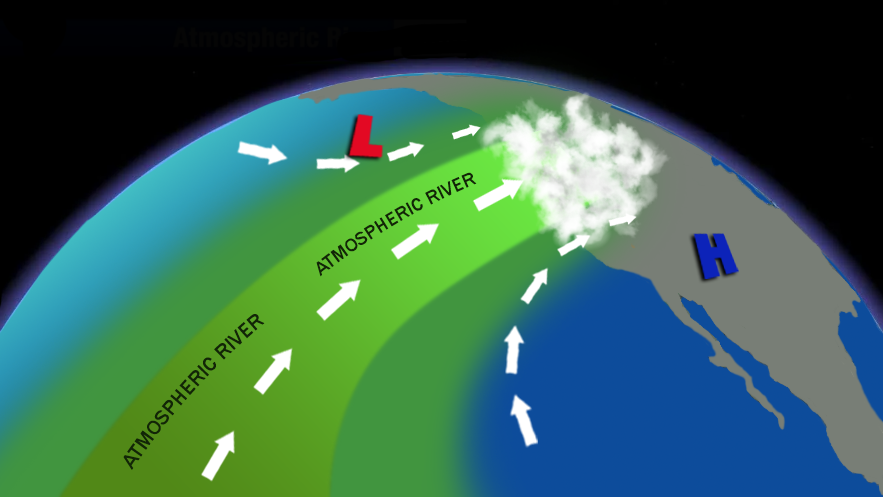
So, what is an atmospheric river? It’s a term used to describe a large concentration of moisture in the atmosphere, which, from above, appears to be a literal river in the sky. The phenomenon acts as a water vapor transport mechanism and moves several trillion gallons of water daily, making it Earth’s largest freshwater transport mechanism. The atmospheric river event is part of a larger extratropical cyclone system, which pushes moisture to the poles from the tropics. They generally occur during the winter seasons of their respective hemispheres, although temporal variability is also prevalent. These rivers can stretch up to a thousand miles in length and a few hundred miles in width, often making landfall along the western coasts of North America and South America (NASA, n.d.). According to NBC, the atmospheric river is responsible for 20-25% of California’s annual rainfall (NBC Los Angeles, 2024). Yet, while the atmospheric river event brings heavy rains, the state still struggles with serious droughts, and California’s heavy reliance on unpredictable weather phenomena does not help solve the lack of a steady supply of water. In fact, the atmospheric river’s volatility leads to flash floods, landslides, and high winds in exchange for a momentary relief from extended drought conditions. As the United States Geological Survey puts it, “While weak atmospheric rivers are critical providers of winter rain and snow, strong events can cause extreme flooding, mudslides, and avalanches – damaging life and property” (USGS, n.d., para. 3). To make matters worse, the atmospheric river’s deep correlation to tropical climate cycles and temperature means that its occurrences will only grow in severity and become more unexpected as global warming and climate change impact atmospheric weather patterns. Atmospheric rivers could cause “ between $2.3 and $3.2 billion of damage every year” in the year 2090 if climate change continues (USDA Climate Hubs, n.d.)
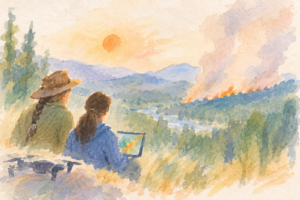
The recent landfalls of atmospheric rivers in California have also been heavily linked to the state’s extreme wildfire conditions. The heavy precipitation leads to rapid and excess vegetation growth, providing endless wildfire fuel in the arid Californian climate as year progresses into drier and windier seasons. The California wildfires during 2020 and 2021, which were the worst the state has seen in its history, were partially caused by the massive atmospheric river events during the winter seasons of 2019 and 2020 (Center for Western Weather and Water Extremes, 2020). By 2100, the “Northwest may see up to a 7-fold increase in instances where extreme rain events follow periods of high wildfire danger within the same year” (USDA Climate Hubs, n.d., para 4). Not only is the atmospheric river a cause of land/mudslides, floods, and damaging storms but it is also correlated to the extremity of wildfires in the following season. However, despite these drawbacks, the atmospheric solution could actually serve to mitigate the severity of wildfires if they occur earlier, particularly before or during the wildfire seasons in late summer and fall. The moisture from atmospheric rivers can reduce the spread of wildfires, as dampened vegetation is a less effective source of fuel and the overall humidity can reduce the rapid spread of fire, which occurs best in drier and windier conditions (Touma et al., 2022).
Still, the atmospheric river event is a phenomenon that is not yet fully understood, and still much remains to be explored. While violent and extreme occurrences can be particularly catastrophic, especially in drier regions such as California, they serve as lifelines to drought-ridden areas and can serve to lessen the extreme fire conditions in places like California. However, with the ongoing problems of climate change and a general trend of weather occurrences growing in severity, we are yet to find out how the atmospheric river will impact California and other regions, or how the effects of global warming will impact the Earth as a whole.
References
Center for Western Weather and Water Extremes. (2020, February 11). CW3E event summary: 4–8 February 2020. University of California San Diego. https://cw3e.ucsd.edu/cw3e-event-summary-4-8-february-2020/
Climate.gov. (2023, February 15). Exploring climate change’s impact on future atmospheric river flood damage in the western U.S. https://www.climate.gov/news-features/feed/exploring-climate-change%E2%80%99s-impact-future-atmospheric-river-flood-damage-western
NBC Los Angeles. (2024, February 1). Explainer: What is an atmospheric river and how does it affect drought in California? https://www.nbclosangeles.com/weather-news/what-is-an-atmospheric-river-rain-storm-drought/3327778/
NASA. (n.d.). Atmospheric rivers. https://ghrc.nsstc.nasa.gov/home/micro-articles/atmospheric-rivers#:~:text=Atmospheric%20rivers%20typically%20occur%20in,of%20North%20and%20South%20America
Touma, D., Stevenson, S., Swain, D. L., Singh, D., Kalashnikov, D. A., & Huang, X., et al. (2022). Climate change increases risk of extreme rainfall following wildfire in the western United States. Science Advances, 8(13). https://doi.org/10.1126/sciadv.abm0320
USDA Climate Hubs. (n.d.). Atmospheric rivers in the Northwest. https://www.climatehubs.usda.gov/hubs/northwest/topic/atmospheric-rivers-northwest-0#:~:text=As%20human%2Dcaused%20climate%20change,and%20more%20hazardous%20on%20average
United States Geological Survey. (n.d.). Linking atmospheric rivers to wildfire patterns. https://www.usgs.gov/programs/climate-adaptation-science-centers/linking-atmospheric-rivers-wildfire-patterns#:~:text=Atmospheric%20rivers%20can%20increase%20the,growth%20and%20temporarily%20inhibits%20fires
The views and opinions expressed are those of the authors and do not necessarily reflect nor represent the Earth Chronicles and its editorial board.