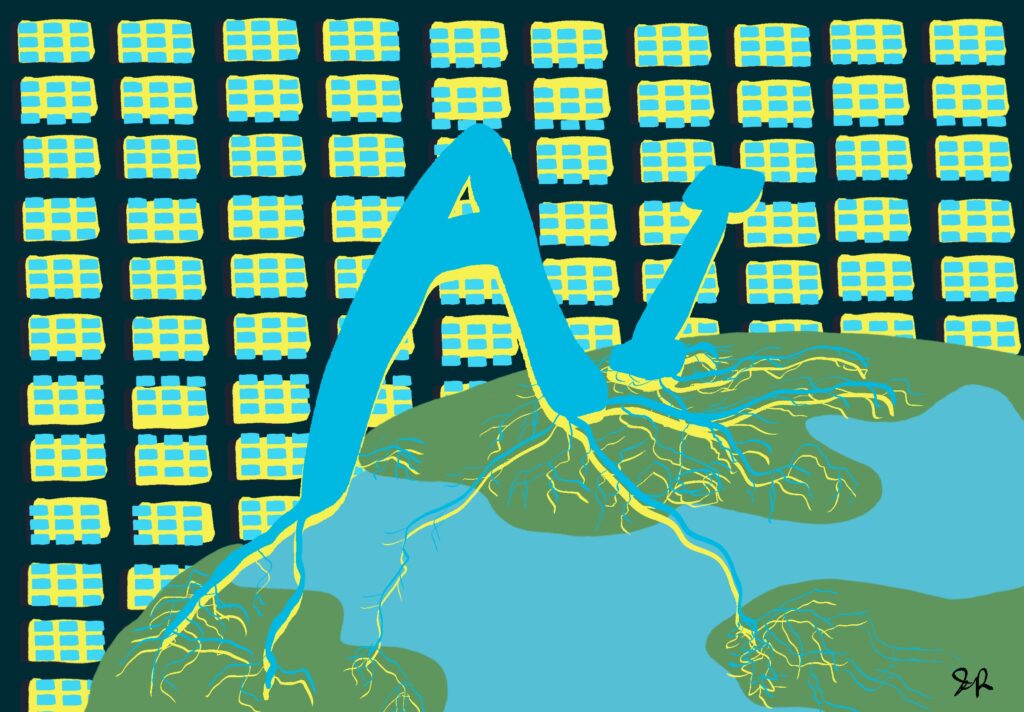
Over the years, artificial intelligence (AI) has become more popular and useful. Many people use it to make daily tasks such as doing homework or setting alarms easier. Even if a person does not use AI personally, a large number of the businesses that they patronize use AI to communicate with customers, analyze data, and complete other necessary tasks. Nowadays, AI can be found in every aspect of a person’s life. While the majority of people use AI, not everybody stops to consider the effects these tools have on the environment. AI leaves a significant impact on the environment through the amount of resources it consumes and the carbon emissions that it produces.
In order for AI to work, data-processing facilities called data centers are required. Not only do these facilities require large amounts of energy, but they receive a large portion of this energy from fossil fuels. In addition to consuming fossil fuels, these data centers also require large amounts of water to cool the equipment. In some areas of the world where water is not as easily accessible, this water usage can place a strain on the environment and the people who live there. Data centers also use a variety of rare Earth elements, including lanthanum, lithium, and cobalt, contributing to their scarcity.
Although there are numerous negative effects of AI, there are also many benefits. AI has revolutionized many industries by making it easier to process information, analyzing data such as medical records, and increasing efficiency. It also makes it easier to complete personal tasks like doing homework and revising resumes.
Earlier this year, North Carolina State University analyzed five case studies about sustainability using AI. These studies highlighted technology companies such as SaveEat and Green Tech Innovations. A few of the sustainable solutions mentioned in the studies include an agriculture platform that uses data to optimize farming and a water management system that is powered by AI. These are only a few examples of how AI can be used to improve our environment in addition to the contributions it makes toward our education and personal lives.
As AI becomes more prominent in this day and age, it is important to consider both the benefits and the costs. While it can improve many aspects of a person’s life, it also takes a heavy toll on the environment. Over time, we will struggle to find fresh water and important elements and face more intense climate change. So, the next time you choose to use artificial intelligence, take a moment to imagine what effect it will have in the long run.
Works Cited
- Volcovici, Valerie, and Laila Kearney. “Data-Center Reliance on Fossil Fuels May Delay Clean-Energy Transition.” Reuters, 21 Nov. 2024, www.reuters.com/technology/artificial-intelligence/how-ai-cloud-computing-may-delay-transition-clean-energy-2024-11-21/.
- “Data Center Energy Needs Are Upending Power Grids and Threatening the Climate | Article | EESI.” Eesi.org, 2025, www.eesi.org/articles/view/data-center-energy-needs-are-upending-power-grids-and-threatening-the-climate.
- Website Development. “Rare Earth Minerals and Their Role in the Ai Expansion – Mining Digest.” Mining Digest, 8 Apr. 2025, miningdigest.com/rare-earth-minerals-and-their-role-in-the-ai-expansion/.
- Avent, Lillian. “How Can AI Be Used in Sustainability? | NC State MEM.” Master of Engineering Management, 22 Apr. 2025, mem.grad.ncsu.edu/2025/04/22/how-can-ai-be-used-in-sustainability/.
The views and opinions expressed are those of the authors and do not necessarily reflect nor represent the Earth Chronicles and its editorial board.