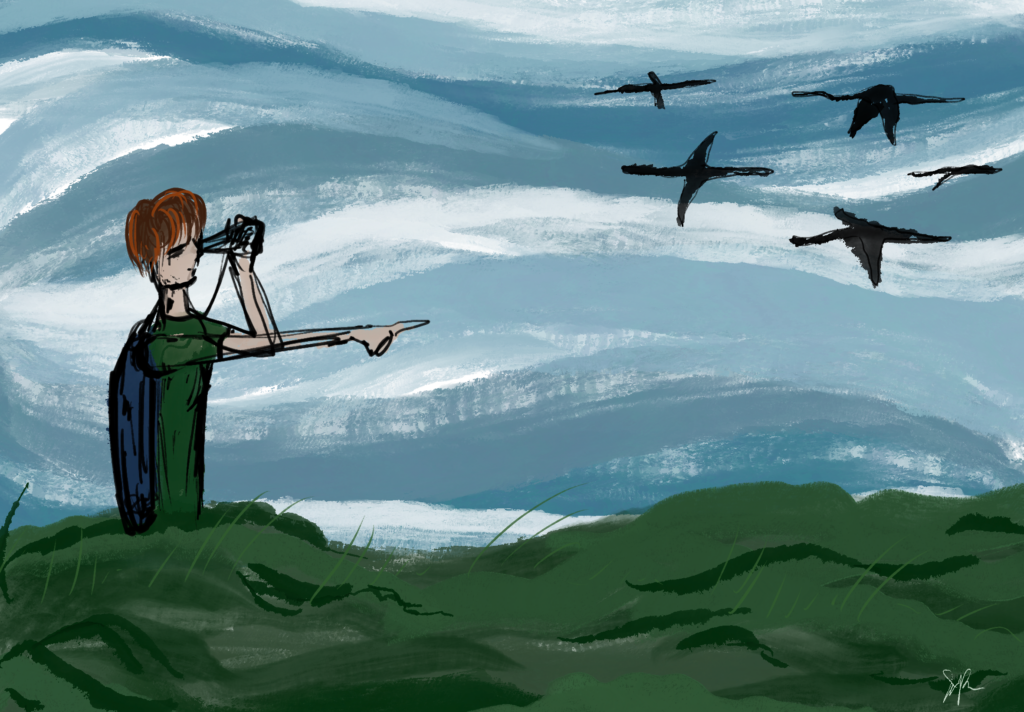
TheIt wasn’t until a good friend of mine took me to see–or rather, hear–the birds that I truly admired them. After school, when other students would start heading home or commit to their other extracurricular responsibilities, my friend and I had other plans. Trusting each other not to make a sound, we would traverse the misty or cold woods right outside our school, and search for their voices.
There is something magical about the moment when the night has all but lifted, and the sky bears a bright shade of a new day, gold and beautiful with birdsong. You may not even be awake to hear the tiny chorus each morning, but you’ve certainly heard them before, at least once. To listen to them is a mystifying–maybe even religious–experience. Birds are among the most inhuman life forms one can imagine. They may be warm-blooded vertebrates, but the fleet-feathered creatures live their lives soaring through free skies with their own wings…an experience no human can ever know. Still, birds are not afraid to engage with us. Despite our dissimilarities, birds constantly feed from the food we leave and glance through windows with the same curiosity we have for them.
In many cultures, mythology characterizes birds with some degree of divine sentiment. Garuda, a bird creature from Hindu mythology is depicted as a human with the head of a falcon or eagle; Hectate, Greek goddess of witches, is described as an owl. In Aztec mythology, Huitzilopochtli, the god of sun and war, is typically portrayed as a hummingbird. Even in the Contemporary Age, we still view birds with reverence and awe.
Scientists may study birds analytically, questioning the evolutionary reasons for how hummingbirds can traverse vast distances. But while the empirical sciences are important, we can also attribute divine qualities to birdwatching. Most of us nowadays, researchers included, don’t attribute any divine qualities to birds—except the birdwatcher, that is. It must be said that the birdwatcher does not need to inherently view birds through a divine or spiritual lens to appreciate them genuinely. However, there is no doubt that there is a special, nonverbal type of connection between ourselves and those adorable avian creatures. Perhaps it is an intimate meeting of souls every time a bird swindles by to chirp and have a bite, even if they are only to leave after a short while.
Henry David Thoreau, the well-known American transcendental philosopher, often conveyed a sort of kinship he felt with birds. He claims that it is not only nature’s wildness that can be found within birds, but a sublime kind of glory.
You may consider birdwatching a relatively passive or even boring activity, but I encourage you to shift your perspective. It is possible to philosophically consider bird consciousness and view the natural world with an almost divine perspective. It is possible to investigate the mysteries of consciousness in living beings, creating a new dimension to science and exploration. But we can also experience birds just as attentively and transcendently as we would any other miracle or wonder in our world.
Learning bird songs is a simple way to admire their beauty. Anyone can learn to identify at least a few of the birds they hear every day. You can start by focusing on your surroundings, and honing in on the call of a specific bird that captures your attention. Looking out for the bird and keeping your eye on it can help, too! This is because the brain links sounds to visuals for stronger memory recall. Harmonizing the bird call yourself can help you remember its rhythm, as well. As you practice your ability to evaluate the similarities and differences in songs, you also master the art of attentiveness. Eventually, you’ll light up with joy at the recognition of a song you are familiar with, a silent revelation that you formed a deeper connection with the world around you.
I strongly recommend aspiring birdwatchers to download Merlin Bird ID. This app was first recommended to me by the friend I mentioned earlier, and it has helped me tremendously on my birdwatching ventures. The Merlin Bird ID app identifies North, Central, South American, and European birds according to their recorded bird song. Learning bird songs is a bit like learning a new language; it opens up new neural pathways in our brains. Similarly, it will get easier as you keep listening and practicing. You might discern whether you are hearing one bird or several, or if you can see any of the birds you are hearing. You might even surprise yourself when you recognize a song in town or at a park. Being able to identify even a few birds by their songs is rewarding, and fills you with a sense of accomplishment and joy, while enhancing your connection with nature.
If you are already a birdwatcher, what I’m saying most likely already resonates with you. You might harbor a deep appreciation for them, or even value them through a divine or spiritual lens. You might observe and count the various species of birds that visit your feeder, or maybe journal and draw them. However you approach birdwatching, it may be rewarding to reflect on birds with a philosophical or religious perspective, if you are inclined towards a specific faith. Any way you do so, it is worthwhile to marvel at the complex, interconnecting essence of nature in all the forms it takes. It is worthwhile to become friends with the chickadee and the starling, and of course, all of nature. As you examine and study nature, do not forget to treat them as a friend. Thoreau once said that he “would rather hold [a bird] in [his] affections” than in his hand (Thoreau 253).
Works Cited
Bruno, Beth Nash. “The Art of Identifying Birds by Their Songs.” Medium, Human Parts, 25 June 2019, humanparts.medium.com/the-art-of-identifying-birds-by-their-songs-916ae2e53cdf.
Fruhling, Zachary. “Zachary Fruhling.” Zachary Fruhling, 3 May 2020, www.zacharyfruhling.com/philosophy-blog/is-birdwatching-philosophical.
Thoreau, Henry David. Vi May, 1854 (et. 36) May 1 . A Fine, Clear Morning after Three Days Of, www.walden.org/wp-content/uploads/2016/02/Journal-6-Chapter-6.pdf
The views and opinions expressed are those of the authors and do not necessarily reflect nor represent the Earth Chronicles and its editorial board.





Comments are closed.