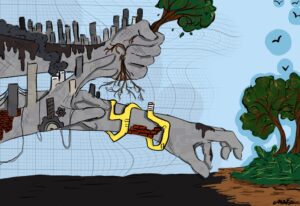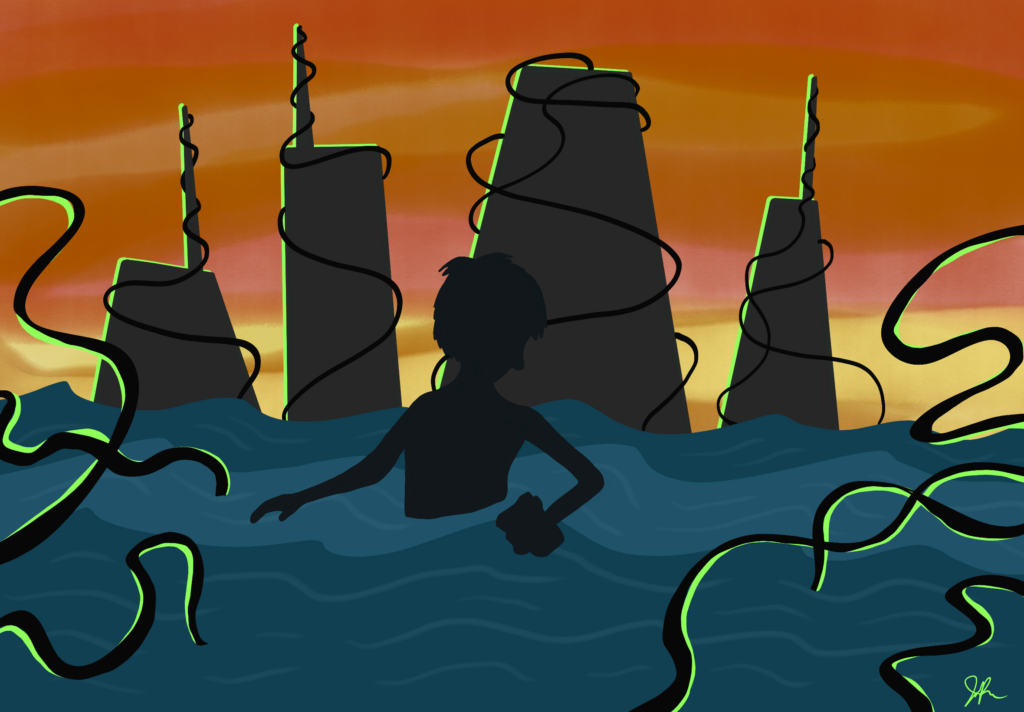
The water is a sheet of ice over Kang’s bare feet as he splashes into the wicked sea, blackened beneath a clouded sky. Wires coil like tree roots beneath his toes, stabbing through the dark surface glazed with froth. They weave into the shadowed depths and stretch in labyrinths across the shore, climbing like strange vines up steel edifices and bridges that hang suspended between. He stumbles and the sea sloshes up towards his chest; he feels it like claws digging into his heart. He wavers in the water, clutching a small flask to his stomach.
Kang bends down in the bitterness, sweeping the flask through the cold. His feet go numb among a grid of wires that pulse in a way he will never decode. The water trickles through the flask, sifting out the salt. He shakes it once more, hoping to purify enough for the day at least, so he won’t have to wander into this frigid sea again. Droplets stick to him in beads and chill him to the bone.
Satisfied, he tugs towards the shore, where beyond him stacks of mechanical grids pile high, clustering and clamoring for space. They spout more wires, some thick as sewer pipes, trembling with electricity. Kang wonders if the lights will turn on at home today. They’ve already lost their water.
So he runs, dashes with naked feet that leave dark prints upon the gloss of iron bridges, the vessel of water bouncing against his chest like a second heartbeat. The city around him flickers intermittently—even the temple lights are thrust into darkness, the wires tangled around stone statues winding towards the sea. The wide televisions spanning stories are overrun with construction updates, notices for more unsettling complexes to be placed on this urban port city nestled on the edge of the East Sea. It has been tainted, he figures, muffled in the incessant hum of data centers.
They run day and night, lurk beneath the sea, suction water and light out of homes. More and more each year, like alien landings that creep closer to Kang’s world. He’s heard the news, after all. That artificial intelligence leeches energy from these imposing structures. That the plethora of wires he has ashamedly grown accustomed to weave through his family’s house—which just brushes the coast—feeds a machine he cannot fully imagine.
He turns down an alley where the aroma of pork belly—one of the few delicacies they’ve been able to enjoy—swirls in smoke through open windows and strings of lanterns hang low to light up the homes. Pockets of the sea can still be glimpsed between the tightly packed ramshackle building projects. When Kang enters his house, the dim lights overhead barely illuminate the room. Shadows clutch the sparse furniture clustered in the corners, and a dark pot rests on a small stove. It’s usually out of luck that the stove works. He drops the flask of fresh water on the table.
“Good, you’re home,” his mother says, pinching his cheek.
“Yeah,” Kang answers, shaking out his damp hair, his whole body ice. “I’m glad you managed to cook. The electricity has gone out all over.”
His mother passes a bowl of pork over to him, which burns with salt and tastes like fire but warms his chest nonetheless. Her own portion is noticeably smaller, and Kang knows the sacrifice she has made, continues to make, as their world seems to close around them. His eyes dart up to her and her own cloud with sadness. His throat clogs with something other than food.
“It’s getting worse. There’s more of those data centers. I saw today. The construction isn’t going to stop, is it?”
His mother gazes down at her reflection in the bottom of the bowl. The porcelain fades her out. “I’m sorry, Kang. It wasn’t always like this. They didn’t see it all the way we can…with the machines and things now…”
“I know.”
“They thought, maybe it isn’t so bad to have the thinking done for you if all you have to do is build more of these, find some throwaway port city to feed your self-thinking computers. If all you have to do is just make people give up a little more from ourselves—of ourselves.”
He’s heard this before, but it still feels like broken glass through his palms. “But why? Why did we let someone we don’t know just treat us like this—this well of energy and learn to live with this?”
“It was a different time, Kang. We were hit the hardest by all the flooding. You know that. We needed safety. Protection. We thought the data centers could do that in a way humans didn’t give us. We didn’t know that some are never satisfied.”
“I guess that means that when humans are flawed, the things we make are too,” Kang says.
Kang turns to the window, where a sliver of sea peeks out from behind the metal and grime, where it still swirls untamed around a lattice of wire. It hasn’t been free, either, he figures, since Kang was four years old, when everything started. A lot can change in nine years.
If he tries hard enough, there is a sea in his heart that is of saltwater and sun and a city in his soul where fish with silver scales teem from market stalls and water flows clear from faucets and this world he knows is not just a socket. There is a boy that looks just like him whose eyes are bright and full, with dark black hair and a bowl of soup that tastes like summer and a sky crowded with constellations. A boy whose backyard is the sea.
He knows that maybe this world is too far gone. But it has to start with someone.
The views and opinions expressed are those of the authors and do not necessarily reflect nor represent the Earth Chronicles and its editorial board.