During her fourth winter in Ohio, the wind had lost its bite and instead blew warmly as it whooshed through the courtyard. On bare sidewalks, students wearing thin layers and jackets around their waists trudged to classes. The landscape was dotted by trees that held firmly onto their still browning leaves. And sitting on a wooden bench was Shula with her brow furrowed in frustration, blankly staring at her blank notebook as if it was a brick wall.
The revving of engines and the smell of car exhaust made it difficult to think straight despite her thinking that breathing in the outside air would clear her mind. But the air was far from crisp and refreshing. Shula would have rather stayed in her stuffy and cramped room than remain in such a pollution-tainted area.
She groaned as she remembered her environmental engineering professor’s lingering words about her final project: “Impress me!” Back home in Kerala, India, her mother would have kept her overcommitting tendencies in check, or guided her along the way with encouragement and homemade snacks. Her father would have said that girls wouldn’t make money by fiddling with knicknacks, but still asked her how her latest projects were going with begrudging interest. Her siblings would be ecstatic that their fun older sister was making another cool machine, as they put it, and try bringing materials from the junkyard under the beating sun to help.
But back home in Kerala, with the eroded beaches and the rising flood waters, the once familiar scenery no longer looked like her home. Her family had escaped from the floods, forced to become climate migrants. Her mother turned withdrawn and tired. Her father was never around anymore and worked day and night to support them. The playful energy of her siblings had withered away along with their resources. But Shula, thanks to a scholarship, was sitting on a bench at university, mind empty of solutions and full of questions, following her dreams, but alone. Not even the leaves dared to fall from the trees to comfort her that the cycles of nature had kept moving, that nature had somehow overcome the floods, droughts, hurricanes, and heatwaves.
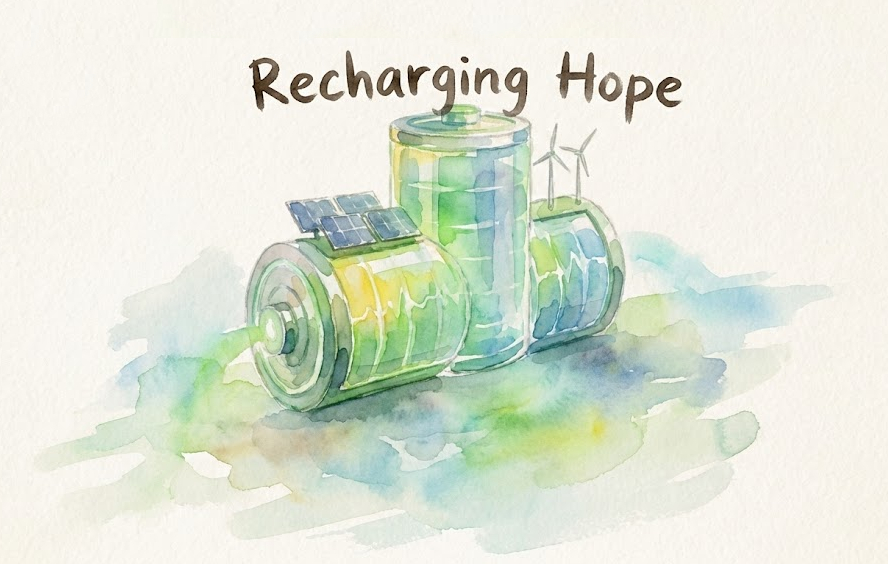
Her idea for the class project had been simple: design batteries that could efficiently store energy from solar panels. The vision had been, indeed, easy enough to come up with. Solar power has generated three times the amount of energy as it did a decade ago. For Shula, the ideal project was the one that could improve humanity’s harnessing of the future’s energy source because renewable energy would halt one of the largest contributors to climate change: fossil fuels.
Greenhouse gases produced by regular human activities such as burning fossil fuels, deforestation, and production of plastics trap heat in the atmosphere and increase global temperatures. Unfortunately, this causes a series of ripple effects, including higher levels of
precipitation and melting glaciers, which both contributed to floods like the one that had ravaged Shula’s home.
Despite her hope for her idea, Shula discovered many potential issues with the batteries she would improve the design of. The main commercially available type of solar battery, LiFePO4(LFP) batteries, and batteries in general were far from perfect. Firstly, their high price deters most people from buying them since one costs at least 10,000 dollars. To make things worse, producing LFP emits more greenhouse gases than making a fossil fuel-powered battery, not to mention the heavy metals that are released into the environment from disposing them. She couldn’t work with a technology with such glaring weaknesses that catapulted global warming further forward rather than pushing back.
Shula exhaled slowly. There was only so much to be gained from sitting alone and overthinking. She collected her bag and left the courtyard to go to the library. Perhaps she could research a different battery to work on making, one that didn’t involve toxic metals. “Hey, Shula!” a chipper voice called.
Shula groaned internally. “Hi, Trisha,” she said unenthusiastically. “I was just about to head to the library.”
Trisha was her roommate. Shula didn’t hate her, but she got on her nerves constantly because of her complete oblivion to the harm she caused to the environment with her seemingly inconsequential habits. Drinking from single use plastic bottles. Leaving her car engine running. Letting the tap water flow when she wasn’t using it. Shula couldn’t understand how Trisha couldn’t be aware of the problems that she caused, but she knew for certain that they had grown up in very different backgrounds: one constantly waking up in the middle of the night, paranoid of sudden floods, and the other enjoying the luxury of burning fossil fuels without worrying about if she would someday be enveloped by towering waves.
“How are you?” Trisha asked with a bright smile, blonde hair slightly swaying in the wind. Without waiting for a reply, she said, “Are you going to the library? I have so much work to do… Let’s go together!”
Unable to refuse, Shula just nodded with a faint smile and led the way forward. A gust of strong wind blew away a plastic bottle teetering on the edge of an overflowing trash can covered in gum and cigarette ashes. The see-through mass of flimsy fossil fuel bounced a few times on the sidewalk before rolling to a stop. Shula sighed and bent over to pick it up.
Trisha grimaced. “That’s so unsanitary! Why are you touching it? It’ll end up in the trash at some point.”
“And that ‘some point’ will be now,” Shula retorted.
“Fine. Take this napkin, then.” Trisha dug up a crinkled napkin from a Dunkin Donuts and passed it to Shula.
“Oh… Thanks.”
After she threw out the bottle in the recycling and Trisha’s napkin in the landfill, they continued down the road in silence until they found a quiet place in the library. Shula immediately opened her computer and started searching.
Some well chosen keywords later, she found it: Vanadium Redox Flow Batteries. According to her web search, they were rechargeable batteries that use vanadium ions that store and release energy in liquid electrolytes. Also, they have a longer lifespan than LFP and have less environmental impact since vanadium degrades naturally unlike lithium. They were already being used in China to store energy from solar panels and had reduced emissions by 1.6 tonnes. However, they had a significant drawback: they could only output 70-80% of the electricity that was stored in them, in contrast to the 90% of most other batteries. Shula smiled—she could fix that. Some researchers had already cleared the path to make vanadium batteries more efficient; being able to control the flow of electrolytes through the battery depending on the external conditions helped. Perhaps Shula could design a computer program to modulate the flow, or change the internal design… the possibilities were endless. Her heart raced at the thought of becoming one step closer to helping the planet.
“Ooh, what are you doing?” Trisha asked.
Holding in an exasperated sigh, Shula answered, “My environmental engineering project. I’ll be designing vanadium batteries to be able to hold energy more efficiently when paired with solar panels.”
“Solar panels, huh? I don’t know anyone that uses them, though.” Trisha went back to reading her textbook as if she had said nothing.
At that moment, Shula finally snapped. Why should she stay silent as people ignored the problem, the people who were working to solve it, and migrants like her, who were affected the most?
She argued back, “You may think it’s really not that important, but it is, Trisha. Solar energy is the fastest growing energy source in the States. Plenty of people are using it, you just don’t know about it. It is, no, it has to be our future if we want to keep the planet healthy. That’s what I’m working for, for the planet to be restored. Not for rich people to be able to say that they have helped the environment, but for the people who are forced to migrate, forced to abandon everything, to have homes again.”
Shula felt bad that she was lashing out at her roommate, but she also knew that it was time for a wake-up call for most people living in privileged countries. They may have grown up in cities spewing smoke and littered with plastic, but it was people like Shula and
her family who were harmed the most. She tried to stay calm as she thought about how different her life would be if not for the overconsumption and luxury that wealthy areas were indulging in, causing climate change along with a myriad of other environmental issues. She would probably still be home, attending a local university instead of being halfway across the world, away from everything she ever knew. She would not be haunted by memories of escaping to higher ground or having to wade in waist high water to go back for her brother who had been sleeping, oblivious and dreaming.
“Sorry, I didn’t mean it like that,” Trisha said. “I know what you’re doing is important… I guess it’s hard to think about things that don’t seem to affect me as much.” Keeping up the momentum, Shula replied, “Climate change affects everyone, even in America. There might not be a beautiful fall foliage this year. Or winter snow. Then, more places will suffer from natural disasters because of rising temperatures, like hurricanes and… floods. Not to mention all the people who are displaced because of extreme weather.” After a moment, she decided to add, “I am one of those people. So, please try to be more aware from now on.”
Shula was awed that she could actually muster the courage to defend herself. But it wasn’t just for her that she spoke up and chose to study environmental issues and engineering; it was for everyone who was and would be hurt by climate change.
“I…. Didn’t know that. If I’m being honest, I don’t know if the situation will ever get better. Every bit of progress that people make towards fighting back seems to be more and more insignificant against the majority who cause and continue to cause enormous amounts of harm. But… I’ll try to learn more and help. It’s inspiring to see someone so motivated to solve the actual problem. I guess the least I can do is stop being part of the issue.” Trisha smiled bittersweetly. “Can you tell me more about the batteries? My homework can wait an hour or two.”
Maybe there was a side of Trisha that Shula had not noticed before. Hadn’t she offered her a napkin to pick up the plastic bottle? Hadn’t she now expressed interest in wanting to learn more and reconsider her viewpoint? Perhaps Shula had also been ignorant of the hopelessness Trisha had gone through and was hiding.
But despite everything, in Shula’s heart sparked a glimmer of hope, a hope she wished to recharge in others as well, hope that people and the climate could change for the better. Step by step, one choice, one habit, one battery at a time, humanity would get closer to restoring and respecting the planet. One day, she would be able to return to Kerala, and enjoy the pristine beaches and the waves crashing at her feet. One day, she would be able to show her siblings the beauties of untainted nature, watching the look of awe on their faces as they stared at their glimmering reflection in the pristine water. One day, her family would
be pieced back together in a stable world, not worrying about having to abandon their home ever again.
Works Cited
“Kerala Flood 2018: Disaster of the Century.” PreventionWeb,
https://recovery.preventionweb.net/publication/kerala-flood-2018-disaster-century
“Kerala Floods Report.” Sustainable Policy Research Foundation (SPRF), 2024,
https://sprf.in/wp-content/uploads/2024/12/keralaaa.pdf
“Kerala Floods Explained.” The Economist,
https://www.economist.com/video/CUAnDxAXGHQ/ehmUOrbw
“Solar Power: Pros and Cons.” PVcase,
https://pvcase.com/blog/solar-power-pros-and-cons
“LiFePO4 vs Lithium-Ion Batteries.” Anker,
https://www.anker.com/blogs/others/lifepo4-vs-lithium-ion
“The Pros and Cons of Lithium-Ion Batteries: A Deep Dive.” Bioenno Power,
https://www.bioennopower.com/blogs/news/the-pros-and-cons-of-lithium-ion-batteries-a-deep-dive
“What Is Round Trip Efficiency in Battery Storage?” GivEnergy,
https://givenergy.co.uk/what-is-round-trip-efficiency-in-battery-storage
“Vanadium Redox Flow Batteries.” AZoM,
https://www.azom.com/article.aspx?ArticleID=24515
“Environmental Impacts of Lithium-Ion Batteries.” Institute for Energy Research,
https://www.instituteforenergyresearch.org/renewable/environmental-impacts-of-lithium-ion-batteries
“Vanadium Redox Flow Battery Efficiency Study.” ScienceDirect,
https://www.sciencedirect.com/science/article/abs/pii/S0306261920300441
“China Completes World’s Largest Vanadium Flow Battery Plant.” ESS News, 2025,
https://www.ess-news.com/2025/07/04/china-completes-worlds-largest-vanadium-flow-battery-plant
“Solar and Wind Energy Growth 2025.” Climate Central,
https://www.climatecentral.org/climate-matters/solar-and-wind-2025
The Atlas of Environmental Migration. Google Books,
https://www.google.co.kr/books/edition/The_Atlas_of_Environmental_Migration/m92VDQAAQBAJ
The views and opinions expressed are those of the authors and do not necessarily reflect nor represent the Earth Chronicles and its editorial board.


Comments are closed.