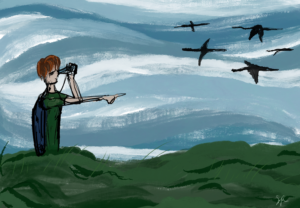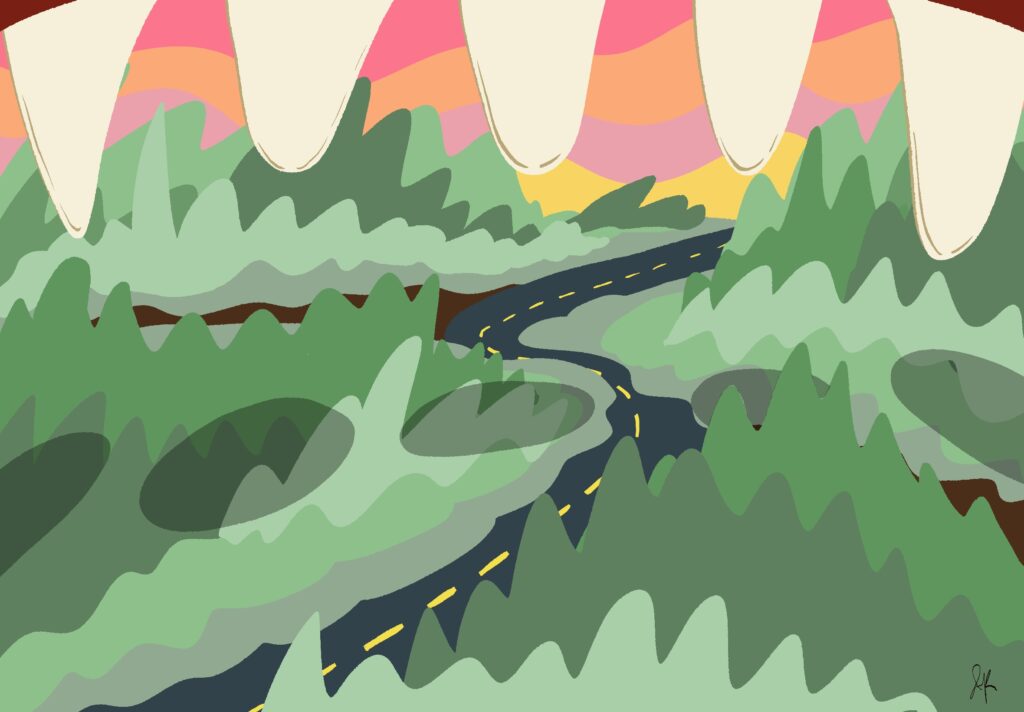
The wilderness stretches endlessly before you, an ocean of tundra and silence. The air buzzes with life and the softness of nature, interrupted only by the murmur of a stream or the soft call of a distant animal. This is one of the last places on Earth where the world still breathes freely, a place that humanity has not sunk its teeth into.
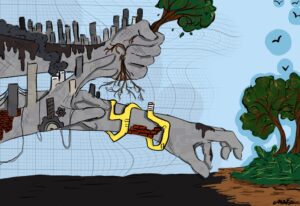
Far from that natural silence, in some office, bureaucrats are drawing up plans. Blueprints for a 211-mile industrial road that would carve through the Brooks Range, cutting across permafrost, rivers, and migration paths in the name of precious metals. The Ambler Road promises the metals needed for electric cars and solar panels, but its cost could be measured in the loss of a land that has never been ours to take.
The Ambler Road
Commonly referred to as the Ambler Mining District Industrial Access Project in Alaska, it encompasses a planned 211-mile private industrial road designed to connect the Dalton Highway to the remote Ambler Mining District. The project aims to provide access to the district’s rich mineral deposits, such as copper and cobalt, for mining purposes. However, it has faced controversy and legal challenges over environmental and cultural impacts. The road would cross 11 major river systems and thousands of smaller rivers, streams, and wetlands critical to fish and wildlife and the communities that depend on them, requiring about 48 bridges and nearly 3,000 culverts.
Despite these challenges, several key players have emerged to spearhead the project. Trilogy Metals Inc., a private Canadian mining company, has taken the lead in the initial stage. They are joined by South32 Limited, a mining and metals company from Australia. Both companies have partnered with the Alaska Industrial Development and Export Authority (AIDEA) to develop the Ambler Road project. Trilogy Metals and South32 uses both open-pit and underground mining methods, with environmental impacts including habitat destruction, water and soil contamination from heavy metals and chemicals, acid mine drainage, landscape alteration, and air pollution from dust and emissions. If allowed to practice these methods in a habitat system as critical and sensitive as Alaska, environmental disasters will only follow.
The Ambler Road project was initially formulated from 2017 to 2021 under the first Trump administration; however, the Biden Administration terminated such plans in 2024. In October of the current year, President Donald Trump approved the Ambler Road project to unlock Alaska’s mineral potential. Trump cited that the past decisions “ignored Alaska’s economic needs and national security imperatives.” With a simple signature, the project was approved, signing the death certificate for an entire ecosystem.
In addition to approving the project, the U.S. government announced a partnership with Trilogy Metals, investing $35.6 million to support mining exploration in Alaska’s Ambler Mining District. This investment makes the U.S. government a 10% shareholder in Trilogy Metals and includes warrants to purchase an additional 7.5% of the company. This type of precedent has become all too common in modernity, the ability to sell off massive portions of land to fund the most recent project while sacrificing the place we call home. Along with the U.S. government’s direct statement that it now holds shares in Trilogy Metals, several sources have pointed to President Donald Trump owning stocks in BHP Billiton, the parent company of South32, potentially creating a conflict of interest within the Oval Office.
The Environmental Impact
Proponents of the project have cited an influx of economic benefits. The projected amount of jobs created from creating the road and keeping it functional is not a negligible statistic. Neither is the flood of mineral resources that Alaska would begin to export following the road’s creation, and the potential for even more industrialization within the region. But can we truly risk our environment for our economy?
Numerous opponents of the project have raised concerns regarding its environmental impact. One such ecological impact would be the destruction and reshaping of nearby ecosystems. The road would bisect the migration route of the Western Arctic caribou herd, which already has populations at their lowest levels in 40 years, and fragment its habitat. The road would also fragment wetlands, degrade water quality from construction, and potentially cause mining activity. Fish species in the area would be significantly affected by the current proposal, which would cross over 3,000 streams, rivers, and creeks, directly impacting spawning and nursery habitats for native fish such as Arctic grayling, sheefish, and various species of salmon. In addition to fish, the road would cross and potentially destroy around 2,000 acres of wetlands vital to local bird species. Coupled with climate change, the road would fragment already sensitive areas, leading to species isolation and potential endangerment.
Furthermore, the road’s construction and operation would likely accelerate permafrost thaw, potentially causing long-term, irreversible damage to the landscape, and culverts and bridges mentioned above would alter natural topography and flood patterns. Construction, vehicle traffic, and potential mining operations could degrade water quality through sedimentation, erosion, and the introduction of toxic heavy-metal pollutants. The road could bisect and degrade over 2,000 acres of wetlands and over 50 linear miles of streams, affecting natural water flow patterns, erosion, and channel migration. An estimated 168 daily round-trip truck trips could release significant amounts of carbon dioxide and other emissions, accelerating the accumulation of GHGs in a sensitive area.
The Human Cost: Indigenous Voices and the Fight for the Land
Opposition to the Ambler Road project has been robust among Alaska Native communities, especially those within the line of “fire”. The Tanana Chiefs Conference, representing 42 Interior Alaska communities, has been vocal in its opposition, citing concerns about the impact on subsistence hunting and fishing rights and the potential harm to cultural practices. The project would impact traditional land use for activities such as berry picking, gathering vegetation, and hunting, and would affect residents’ mental and spiritual well-being. The road threatens the availability and access to critical subsistence resources, such as caribou and fish, that are vital for the food security and cultural well-being of numerous Alaska Native communities. Environmental justice concerns have been raised, with studies indicating that impacts to subsistence and health would disproportionately affect low-income and minority populations, specifically Alaska Native villages, and, coupled with the issues mentioned above, could potentially have enduring consequences on the whole of Alaska’s native population.
The Road Forward
The tundra of the Brooks Range still waits, quiet and unchanged. Whether it remains so depends not only on policy or industry, but on a public ready to look beyond short-term gains and recognize the value of preserving the land, its people, and the ecosystems that have survived there for millennia. By educating yourself, engaging in dialogue, and supporting the voices of those on the frontlines, you can help ensure that Alaska’s silence does not end under the roar of trucks and machinery or under the influence of an office thousands of miles away.
The Ambler Road project exemplifies just one front of a broader debate over balancing economic development with environmental preservation and Indigenous rights. The metals it promises (copper, zinc, cobalt) are essential for building electric vehicles and renewable energy technology. Yet the road to extract them threatens to permanently scar one of the last wild frontiers on Earth. The path forward is not simple, but it begins with awareness and engagement. Readers who wish to form their own opinions or support Indigenous and environmental advocacy can start by learning more from organizations working directly on this issue in the resources for readers section below.
Resources for Readers:
- Tanana Chiefs Conference (TCC) – https://www.tananachiefs.org/noamblerroad
- Native Movement – https://www.nativemovement.org/no-ambler-road
- Alaska Industrial Development and Export Authority (AIDEA) – www.blm.gov/public-input-actions?region%5B0%5D=17&page=4%2C0
- Bureau of Land Management (BLM) – https://www.blm.gov/project/ambler-road-eis
Those who wish to directly contact elected officials and express their views can reach out to Alaska’s representatives:
- Senator Lisa Murkowski – https://www.murkowski.senate.gov
- Senator Dan Sullivan – https://www.sullivan.senate.gov
- Representative Mary Peltola – https://peltola.house.gov
- White House Comment Portal – https://www.whitehouse.gov/contact
Readers can also support advocacy and legal efforts that protect Alaska’s wildlands and Indigenous rights:
- Alaska Wilderness League – https://www.alaskawild.org
- Earthjustice – https://earthjustice.org
- National Parks Conservation Association – https://www.npca.org
Works Cited:
“Fact Sheet: President Donald J. Trump Approves Ambler Road Project to Unlock Alaska’s Mineral Potential.” The White House, 27 Oct. 2025, https://www.whitehouse.gov/fact-sheets/2025/10/fact-sheet-president-donald-j-trump-approves-ambler-road-project-to-unlock-alaskas-mineral-potential/.
Helmer, Daniel. “Trump Administration Approves Ambler Road.” Outdoor Life, 2025, https://www.outdoorlife.com/conservation/trump-administration-approves-ambler-road/#:~:text=While%20some%20Alaskans%20do%20want,we%20don’t%20know.”&text=The%20Western%20Arctic%20Herd%20was,an%20estimated%20152%2C000%20in%202023.
“The Eight Ws of Ambler Road.” Audubon Alaska, 2025, https://ak.audubon.org/news/eight-ws-of-ambler-road#:~:text=The%20Evansville%20Tribal%20Council%20calculates%20that%20the,of%20boreal%20birds%20already%20face%20significant%20decline.
Gates, Bill. “Gates of the Arctic: Scenes from a Park at a Crossroads.” National Parks Conservation Association, 2025, https://www.npca.org/articles/11036-gates-of-the-arctic-scenes-from-a-park-at-a-crossroads#:~:text=The%20road%20will%20have%20to,the%20landscape%2C%20will%20be%20jeopardized.
“Trilogy Metals Announces Strategic Investment by U.S. Federal Government.” Trilogy Metals Inc., 2025, https://trilogymetals.com/news-and-media/news/trilogy-metals-announces-strategic-investment-by-us-federal-government/#:~:text=The%20Ambler%20Access%20Project%20or,Executive%20Officer%20of%20Trilogy%20Metals.
“Bornite Property.” Trilogy Metals Inc., 2025, https://trilogymetals.com/properties/bornite/#:~:text=Mineral%20resources%20are%20constrained%20by,Metals’%20share%20is%2050%25.
“Arctic Property.” Trilogy Metals Inc., 2025, https://trilogymetals.com/properties/arctic/#:~:text=Key%20Facts&text=We%20announced%20the%20results%20of,amounts%20are%20in%20US%20dollars.
South32. https://www.south32.net.
“Donald Trump Investments.” Advisor’s Edge, 2025, https://www.advisor.ca/investments/market-insights/what-donald-trump-is-invested-in.
“Western Arctic Caribou Herd.” Alaska Department of Fish and Game, 2023, https://www.adfg.alaska.gov/index.cfm?adfg=wildlifenews.view_article&articles_id=1070
The views and opinions expressed are those of the authors and do not necessarily reflect nor represent the Earth Chronicles and its editorial board.