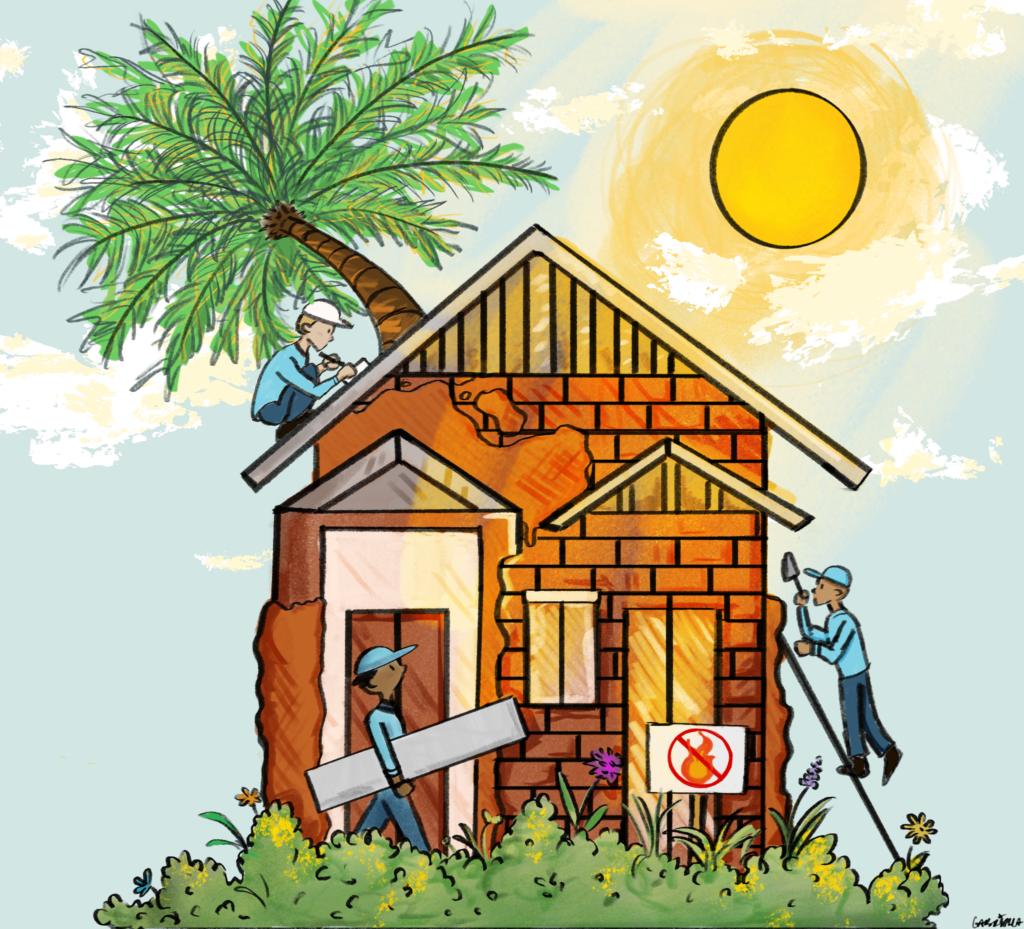
Wildfires have become a defining feature of California’s future and are no longer a surprise. This winter’s Palisades and Eaton fires burned through 57,529 acres, destroyed 18,000 buildings, and displaced more than 200,000 people. Although these wildfires were initially driven by heavy Santa Ana winds reaching hurricane speeds, they were ultimately fueled by a hot, dry climate. Climate change has doubled the number of wildfires in the West since the 1980s, and every degree of warming increases the risk.
If California continues to rebuild as though each fire is an isolated event, neighborhoods will burn once again. Recovery must not mean a return to the status quo. We must fundamentally shift how we build and protect communities in fire-prone areas.
The Current Rebuilding Process Is Broken
Los Angeles is entering the same rebuilding limbo Santa Rosa faced after the 2017 Tubbs Fire. In Santa Rosa, more than 5,000 structures were destroyed. It took months to clear the debris and, on average, over a year to obtain permits.
L.A. faces a worse situation. Obtaining a single-family permit takes an average of 466 days, nearly triple the state median. Moreover, construction will be further delayed by insurance withdrawals and rising costs. Without reform, thousands of residents will spend years waiting to rebuild their homes, or they will leave the state entirely.
Although we all wish to rebuild as quickly as possible, speed alone is not the solution. How we do it will determine whether these communities survive the next fire.
Better Building Practices, So We Don’t Repeat History’s Mistakes
First and foremost, rebuilding efforts must prioritize materials that don’t easily ignite: fiber cement siding, stucco, metal roofs, ember-resistant vents, and double-paned glass. Creating defensible spaces with native, low-flammability plants like toyon and California lilac can help slow the spread of fire. While no plant is completely fireproof, thoughtful landscaping design can give enough time for firefighters to respond effectively.
We must also consider fire protection on a community scale, not just at the household level. This protection can include underground power lines and shared greenbelts, which can prevent a single house fire from spreading to the entire neighborhood.
A promising prospect is the use of firebreaks, an idea originating from China, where researchers have planted over 364,000 kilometers of “green firebreaks.” These firebreaks are strips of low-flammability vegetation strategically placed to slow or stop high-intensity fires. They’re made of plants with high moisture content and low ignition potential, thereby acting as natural buffers. In addition to reducing fire intensity, these firebreaks also protect biodiversity by providing habitats for animals within areas that would otherwise be an unwelcoming city.
If California integrates green firebreak belts around vulnerable communities, especially along the border between mountains and urban areas, it can reduce the spread of wildfires before flames reach homes. While green firebreaks cannot replace firefighters or retrofit, they can buy critical time, making other defenses more effective.
Prevention First
California spends billions of dollars fighting fires every year. However, only a fraction of that money is spent on prevention. As such, we should redirect funds toward retrofitting vulnerable homes, community-level vegetation and firebreak planning, and establishing permanent fire-resilience officers for faster permits and enhanced protection.
In the long term, this method would not only prevent catastrophic losses but also save money, as initially better-protected houses are significantly less likely to require rebuilding.
Addressing the Root Cause
Even the best firebreaks and strongest roofs cannot withstand infinite heat. Wildfires are becoming more extreme as climate change continues to worsen. We are seeing the disastrous effects of climate change on human life in real time.
To protect California from wildfires, we must prioritize rapid decarbonization and invest in renewable energy. It should no longer be a debate as to whether we can continue relying on fossil fuels for the next couple of decades. We need to act now; otherwise, California and many other wildfire-prone states will face an even more alarming future.
Without climate action, every local solution is just a temporary patch on a burning wound.
A Positive Future
The January 2025 fires should not be viewed as an isolated tragedy but rather as a warning. California can either continue repeating this cycle or develop a new model of wildfire resilience. That means stronger, fire-resistant homes, zoning that prioritizes shared protection, green firebreaks that give us a brief window for response, faster, smarter rebuilding systems, and real climate action.
We know the fire risks are coming, whether that be in a few months or within a year. The only remaining question is how we will prepare for them and how we will prevent them from causing such devastating damage.
Sources
Ades, Daniela. “4 Greenbelt Types That Improve Our Response to Wildfires.” Greenbelt Alliance, 2024, https://www.greenbelt.org/blog/greenbelts-types-responsewildfires/.
Bendix, Aria, and Denise Chow. “California Fires: Rebuilding Quickly Could Put Homes at Risk.” NBC News, 22 Jan. 2025, https://www.nbcnews.com/science/environment/california-fires-rebuild-quickly-could-put-homes-at-risk-rcna188004.
Cui, Xinglei, Md Azharul Alam, George L. W. Perry, Adrian M. Paterson, Sarah V. Wyse, and Timothy J. Curran. “Green Firebreaks as a Management Tool for Wildfires: Lessons from China.” Journal of Environmental Management, vol. 233, 1 Mar. 2019, pp. 329–336. Elsevier, https://doi.org/10.1016/j.jenvman.2018.12.043.
“January 2025 Southern California Wildfires.” Wikipedia, Wikimedia Foundation, 29 Oct. 2025, https://en.wikipedia.org/wiki/January_2025_Southern_California_wildfires.
Knight, Heather, and Conor Dougherty. “How Will L.A. Rebuild? The Recovery From the Wine Country Fire Offers Clues.” The New York Times, 19 Jan. 2025, www.nytimes.com/2025/01/19/us/la-fires-rebuild-tubbs.html.
“Plants – Sustainable Defensible Space.” DefensibleSpace.org, Sustainable Defensible Space, 2025, https://defensiblespace.org/plants/.
“Rebuilding After the Flames: What Does a Fire-Resistant Home Look Like?” Moss & Fog, 9 Jan. 2025, www.mossandfog.com/rebuilding-after-the-flames-what-does-a-fire-resistant-home-look-like/.
The views and opinions expressed are those of the authors and do not necessarily reflect nor represent the Earth Chronicles and its editorial board.