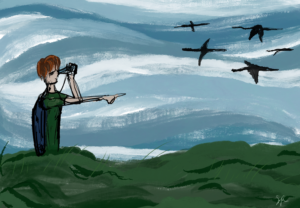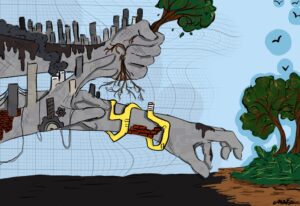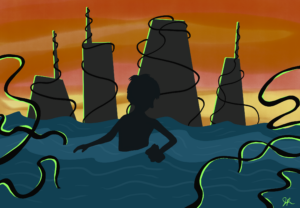
The turning tides are rising. The brown, brittle branches of the forests are splintering like dry bones. The merciless sun is scorching with the carcasses of summers too long, too bright, too blistered with human hubris to be holy. I’ve watched glaciers weep and heard the cries of butterflies. I’ve felt the piercing sting of the saws that stole the trees. I’ve seen Mother Earth scorched to ash.
We brush aside “climate change” as if it were a natural occurrence or a passing storm, as if our malls, our meat, our miles per gallon had nothing to do with it. We curse at the daily weather report and shake our fists at the sky as if the Earth were to blame for its own obituary.
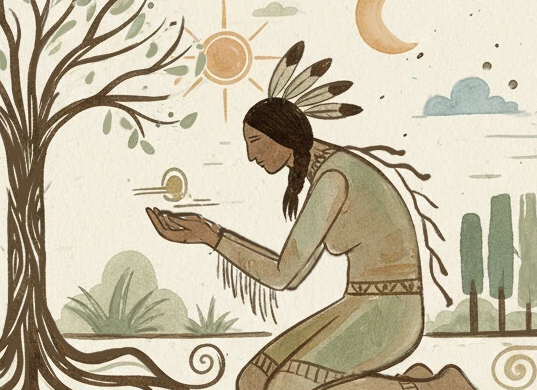
However, it wasn’t always this way. Before we wanted oranges in January and strawberries in the snow–before we wanted a world that bowed to us, there was once a people who lived in harmony with the natural world. Long ago, Mother Earth was full of life, her skin draped in emerald, her heart beating through rivers and roots. She kissed the slender ankles of deer, and bathed the newborn sun in the basin of her open palms. Ferns curled along the forest floor, jeweled in morning dew. The minnows would tickle her feet, and the frogs sang liturgy from the chapels of her reeds.
Like one would tend a garden, early Indigenous communities worked in reciprocity with the land, understanding it as an extension of who they were. From saving seeds and collecting rainwater to rotating hunting grounds and protecting wetlands, Natives recognized and harnessed their interdependence with nature.
After all, this was to their benefit: each community learned to live with the land it called home. While Plains tribes followed bison herds, using every part of the animal and taking only what they needed, communities in the Southwest dug environmentally friendly irrigation canals to grow corn, beans, and squash. Along the coasts, tribes built fishing systems that allowed salmon to return year after year. In forests, people used controlled burns to prevent catastrophic wildfires. From the high plains to dense forests, from deserts to fertile valleys, Natives were stewards of their lands and worked to preserve their ecosystems.
As conservationist John Muir explained, “Indians walk softly and hurt the landscape hardly more than birds or squirrels.” Much of this is because their relationship with the land was both spiritual and practical. The land was not a commodity as we view it now, but something we belong to. It was a sacred duty to honor the living world, a reverence for the Earth and its resources that we’ve since lost. Among the Ojibwe, for example, rivers and lakes were understood to have their own spirits, deserving respect and offerings before people fished or traveled on them.
Unsurprisingly, about 80% of the world’s remaining biodiversity is found on Indigenous lands. A 2019 study from the University of British Columbia found that lands managed or co-managed by Indigenous peoples in Canada, Australia, and Brazil contained more bird, mammal, amphibian, and reptile species than even official parks and protected areas. This finding shows that Indigenous land management practices, like mosaic burning and diverse crop and species mixing, continue to sustain ecosystems, often outperforming modern conservation methods in healing the wounds of colonization.
In fact, Indigenous nations across North America are stepping to the front lines of the fight for environmental restoration. From controlled burns in California forests to clam garden revivals on the Pacific coast, Native communities are applying centuries-old stewardship practices to modern-day environmental challenges. Groups like the Wet’suwet’en land defenders in Canada, the Mashpee Wampanoag in Massachusetts, and the Standing Rock Sioux in North Dakota have rallied against pipelines, mining, and deforestation. These efforts have delayed or stopped large fossil fuel projects, inspired global climate justice movements, and forced governments and corporations to confront their environmental impact.
These are part of a much broader movement by and for Indigenous peoples to reclaim their land. Known as the Land Back movement, the campaign calls for tribes to reconnect with sacred sites, grow Indigenous foods, protect biodiversity, and resuscitate degraded lands and waterways. By restoring their territory and political sovereignty, we all would indirectly assume a collective responsibility to care for the environment.
As wildfires spread and species vanish, we must emulate this mindset by recognizing our dependence on the environment and implementing sustainable practices that prioritize the long-term health of ecosystems. If Indigenous peoples lived sustainably on their lands for thousands of years before colonization, surely we can relearn how to protect what gives us life.
Bibliography (MLA):
“Biodiversity Highest on Indigenous-Managed Lands.” UBC News, 31 July 2019, https://news.ubc.ca/2019/07/biodiversity-highest-on-indigenous-managed-land /.
“Biodiversity Highest on Indigenous-Managed Lands.” EurekAlert!, 31 July 2019, https://www.eurekalert.org/news-releases/664243.
“Indigenous-Managed Lands Found to Harbor More Biodiversity than Protected Areas.” Mongabay, 5 Aug. 2019, https://news.mongabay.com/2019/08/indigenous-managed-lands-found-to-harbor-more-biodiversity-than-protected-areas/.
Muir, John. My First Summer in the Sierra. 1911. Quoted in LibQuotes, https://libquotes.com/john-muir/quote/lbt7g8e.
“The Three Sisters of Indigenous American Agriculture.” U.S. Department of Agriculture National Agricultural Library, https://www.nal.usda.gov/collections/stories/three-sisters.
“Indigenous Peoples of the American Southwest.” Encyclopædia Britannica, https://www.britannica.com/topic/Indigenous-peoples-of-the-American-Southwest.
The views and opinions expressed are those of the authors and do not necessarily reflect nor represent the Earth Chronicles and its editorial board.