When one thinks of science fiction, the following images immediately come to mind:
Neon laser blades cutting through the metal of a monstrous floating sphere.
Resurrected dinosaurs crushing earth and bones beneath their claws.
A time-traveling cyborg confidently saying, “I’ll be back.”
And…blue people?
The Avatar franchise may be hailed as some of the highest-grossing films of all time, even complete with their own theme park attraction. However, many fail to admire them beyond the special effects. After all, what could a couple of movies about unusually tall aliens running through trees for three hours really have to say?
Quite a lot, actually.
For those who don’t know, Avatar begins as a tale of greed gone wrong. Sound familiar? After humans exhaust Earth’s natural resources to the point where it becomes uninhabitable, they are forced to find a new place to continue their civilization. And lo and behold—Pandora zips onto the screen.
Pandora is the fictional world that prominent director and screenwriter James Cameron dreamt up. Complete with lush forests and crystalline seas—the latter introduced in the second film, The Way of Water—the place is an untapped wonderland. Perfect for pillaging. But not if our beloved blue people have anything to say about it.
That’s where the narrator and protagonist, Jake Sully comes in. He’s given the opportunity of a lifetime: to travel to Pandora and force the indigenous humanoid species—better known as Na’vi—to relinquish control of their lands. To do so, Sully’s consciousness is transferred into a bioengineered Na’vi body, also called an Avatar. Hence, Avatar.
Long story short, Sully comes to embrace the Na’vi and their culture, helping them lead a successful revolt against the humans. Cue the next movie.
The Way of Water thrusts Sully into the future, in which he and his mate Neytiri have four children. With everything to lose, Sully faces a renewed threat as the humans attempt once again to annihilate the Na’vi, forcing the family to seek shelter with an ocean clan and learn their ways.
Much like the first movie, the sequel explores similar themes of identity and family, but it takes environmental conservation to the next level.
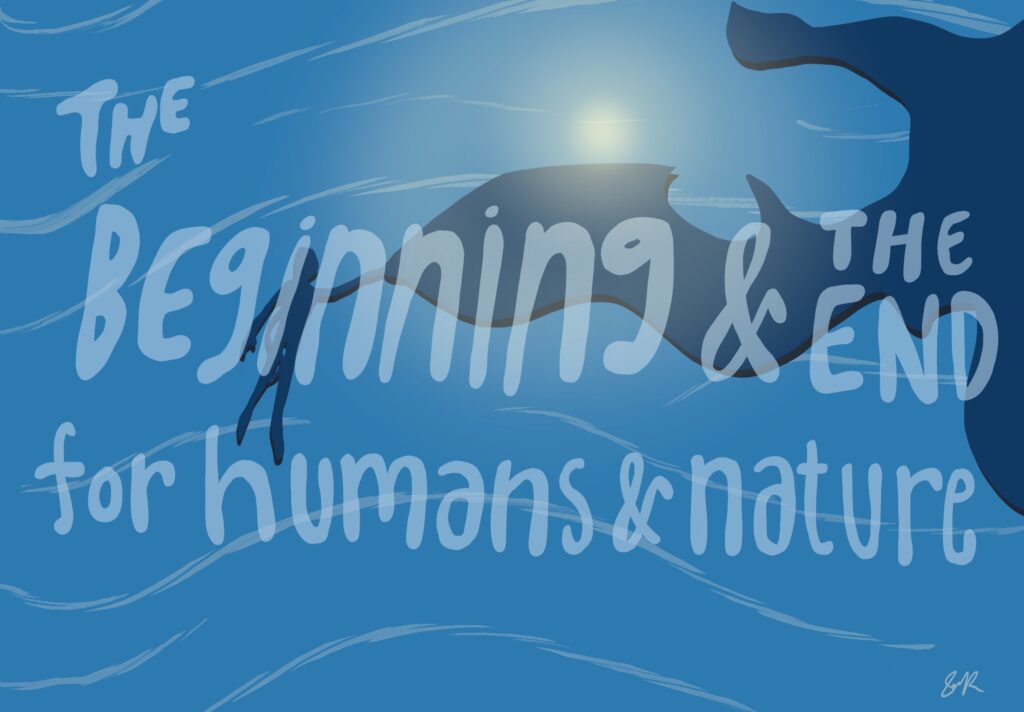
In an interview with IGN, Cameron mentioned that he has a framed image from Way of Water, depicting the scene where Sully’s second-eldest son, Lo’ak, befriends a whale-like creature—or Tulkun—named Payakan, placing his hand on its fin. He explained that this image perfectly encapsulates the franchise’s core message: nature and humans are not separate entities. In fact, they rely on one another for survival, forging a unique yet delicate balance. Only together can both truly thrive.
And if that wasn’t deep enough for you, let’s take a step even further.
Lo’ak, due to Sully’s human blood, is considered a “half-breed,” or not a “true Na’vi.” Therefore, the majority of the ocean clan is, put nicely, less than willing to accept him as anything more than a freak of nature.
Much like him, Payakan is also an outcast, considered a killer for leading an unsuccessful revolt against the humans who were hunting them. And, as is often the human way, we destroy what we do not seek to understand.
Quite the pair, indeed.
But then, something incredible happens—something so extraordinary that it is almost inconceivable to humans today. Lo’ak and Payakan—one humanoid, the other animal—form a bond over their shared struggles. They find an acceptance in each other that they cannot find within their own respective clans.
In fact, their first account was when Lo’ak was abandoned in the open ocean. Payakan saves Lo’ak from another sea creature that wants to make him a midday snack. Then, near the end of the film, Lo’ak has the opportunity to return the favor by saving Payakan from being killed by a squad of professional Tulkun hunters who have marked it as their next target.
Imagine caring so deeply about another individual, let alone a non-human, that you’re willing to sacrifice your own life to save theirs. Such compassion and love transcend any special effects a film enthusiast could rattle off in five seconds flat. Or, at least, it should.
Still in disbelief? Let’s revisit the term “science fiction.”
The Avatar franchise isn’t considered merely scientific fiction because it features highly advanced technology that humans can only now dream of. It’s not about what we don’t have; it’s about what we do have.
Symbiotic relationships are essential to putting the “nature” in “natural.” Specifically, the symbiotic relationship is mutualism, in which both organisms benefit from associating with one another.
While not an exact comparison, Lo’ak and Payakan certainly fit the bill. Each gains companionship, learns from the other’s experiences, and helps one another in times of need—precisely why Lo’ak believes Pakayan is worthy of the title “Brother.”
Additionally, the CDC states that the need for a companion is negatively correlated with significant health risks—from heart disease to depression—meaning that as social interaction increases, the potential for illness decreases.
As for the “fiction” aspect, yes, Avatar is indeed not real. Na’vi, magic whales, and idyllic moons do not exist; they are merely a figment of Cameron’s imagination. However, to quote another literary triumph, “Of course it’s happening inside your head, but why on earth should that mean it is not real?” Harry Potter’s Albus Dumbledore can do no wrong…Well, that’s a story for another article.
Sully and his posse may not be real, but the messages they convey are. Humans can choose to bond with nature and treat it as kindly as they would a family member. We don’t have to continue chopping down trees or bleaching coral at such an exponential rate. Instead, we can strive to understand the world lurking just outside our doors. We can respect what is different from us and, more importantly, recognize how we are similar.
If you have watched or plan to watch the franchise’s latest installment, Avatar: Fire and Ash, keep all of this in mind. And the next time you walk through the trees or swim in the ocean, remember the phrase, “I see you.” Because if you allow it, it will see you, too.
Works Cited
CDC. “Social Connection.” Centers for Disease Control and Prevention,
https://www.cdc.gov/social-connectedness/about/index.html. Accessed 15 Nov. 2025.
IGN. “James Cameron Reveals Avatar: Fire & Ash Details, and Why AI Will Never Write His Scripts.” YouTube,
https://www.youtube.com/watch?v=Qrk2gzzidSg. Accessed 15 Nov. 2025.
Rubin, Rebecca. “‘Avatar: The Way of Water’ Overtakes ‘Titanic’ as the Third-Highest Grossing Movie of All Time.” Variety,
https://variety.com/2023/film/box-office/avatar-2-third-highest-grossing-movie-ever-titanic-1235520614/. Accessed 15 Feb. 2026.
Sager, Jessica. “38 Best Dumbledore Quotes from ‘Harry Potter.’” Yahoo Life,
https://www.yahoo.com/lifestyle/35-dumbledore-quotes-harry-potter-192943423.html. Accessed 15 Nov. 2025.
The views and opinions expressed are those of the authors and do not necessarily reflect nor represent the Earth Chronicles and its editorial board.

Comments are closed.